Wednesday, March 12, 2014
five unusual movies: three pretty good, two not so much
Casa de mi Padre: (2012. dir: Matt Piedmont) You gotta love Will Ferrell, even if you don't like Will Ferrell, for his bottomless well of shamelessness and enthusiasm. Even if, like me, you have had minimal exposure to the Mex-ploitation film industry he's sending up, this is still an enjoyable romp. Entirely in Spanish with subtitles, you get everything you'd expect: the asshole yankee DEA agent (Nick Offerman of Parks and Recreation, BRILLIANT), the flamboyant drug-lord and his newly-encroaching rival (Gael Garcia Bernal and Diego Luna, both having way too much fun), along with very funny pokes at magical realism (if nothing else, you have to see the Ferrell character's power animal) and filled to busting with continuity errors, bad timing, film glitches, buckets of blood splashed over slow-motion massacre scenes, subtitles which don't quite match the spoken words, even a scrolling apology from the second-camera assistant about why they couldn't use the fierce coyote-v-jaguar fight footage.
I laughed out loud twice, I think, but the rest of the time I was pleasantly amused.
Afraid of the Dark: (1991. dir: Mark Peploe) This is a low-key but truly harrowing double-story: about a boy going blind while trying to keep a grip on his life, and the same boy sighted but surrounded by blind people. The possibility of bloodshed lies around every corner, and the characters, having been well-written as normal, everyday people, seem terribly vulnerable and trusting. Utterly unconventional without descending into cleverness, chilling without sacrificing heart, and peopled by an astonishingly good cast (James Fox, Fanny Ardant, Paul McGann, Clare Holman, Susan Wooldridge, Robert Stephens, David Thewlis) speaking refreshingly good dialogue, it kept me on the edge of my seat right up to the end.
Deserter: (2002. dir: Martin Huberty) You watch it for Tom Hardy, sure, but it's also an interesting subject: a young Englishman of Romantic sensibilities (Paul Fox who, amazingly, seems NOT to have been spawned by the James/Edward Fox dynastical empire of acting talent) deals with a broken heart by running away to join the French Foreign Legion (La Legion Estrangere. Isn't that gorgeous?) only to find it a gruelling and decidedly unromantic row to hoe. The movie is lit, however, so that everything, --the desert, the medina in Algiers, the barracks, --everything looks beautiful, which you'd think would negate the point a bit, since the point (you'd think) would be the ugliness of reality. That's a red herring, though: really, this is a Hallmark-Movie-of-the-Week thing, designed ultimately to warm the cockles of your heart, convince you that the world is at last safe and warm and that destiny is in your corner, rooting for both your comfort and ultimate joy. That, in the end, all this which looks, at first glance, like chaos actually makes all kinds of sense, the fairy-tale, happily-ever-after, soul-mates-will-find-each-other and God-is-in-His-Heaven kind of sense.
I had hoped to learn some about the Algerian War of Independence, but this is all so simple-minded as to be a little insulting to everyone involved. (I did learn that when De Gaulle announced France would be pulling out and leaving the country to its own devices, the French Foreign Legion took over the airport and was on the verge of instigating a coup, which is interesting.) The worst of it is that there is a late, climactic moment between two great friends, a moment which ought to have been quite devastatingly effective, particularly since Tom Hardy was involved (and he is, as always, lovely in this). But because we are being led delicately by the hand as if children through a war-torn landscape bearing only the vaguest resemblance to anything in the real world, the moment passes without conjuring emotion. Or, anyway, conjuring something so small and un-upsetting that it bears only the vaguest resemblance to true emotion.
Recommended for Hardy completists only.
North Fork: (2003. dir: Michael Polish) An American town in the fifties is about to be drowned beneath a man-made lake. Pairs of men in identical gray business suits are dispersed to disearth the stubborn stragglers to higher ground. Simultaneously, a dying boy dreams his death-hallucination which brings the objects on his night-table to life.
An interesting monochromatic landscape, good cinematography, and a pace set at a daring but exact amble using a veritable battalion of very good actors cannot combat the boatload of whimsy involved, so particularly contrived as to be downright leaden, sinking the movie straight to the bottom where it thumps along, occasionally managing a raised flipper, but never rising into any true sign of life. Too bad. It was an interesting notion.
the Adjustment Bureau: (2011. dir: George Nolfi) A nice love story, care of Philip K Dick. Actually, I suspect much of the Philip K Dick has been filtered out, because it's a little too nice, a little too simple, but you can feel the author's sensibility still honored.
Pretty-boy Congressman David Norris is in the end-run for his Senate bid, and looking like a shoe-in when a frat-boy prank scandal threatens to end his political career for good. I should point out that this early part of the film, an accelerated, bullet-points-only view of his campaign, is masterfully done, giving us just enough to care about the guy, at the same time not hiding his insincere, politician side. (His campaign manager, wonderfully, is Michael Kelly, whom you'll recognize as Doug Stamper from House of Cards.) At this point we are introduced to a team of suited, tied, and hatted Men in Grey who are unknown to our characters but obviously pulling strings to move history in whichever direction suits them, including introducing Norris by apparent accident to Elise, who inspires him to give the speech of his life which puts him back on track to public office.
That's as much plot as I feel comfortable revealing. Suffice to say that Matt Damon and Emily Blunt are a good-time couple to hang out with; I've never enjoyed Damon's company so much. True, they do spend too much time running up endless staircases and opening doors onto terraces they just left, -- call it Philip K Dick, Escher-like, labyrinthine padding, --and the ending is far too tidy. Still, speaking as (on the whole) not-a-fan of romantic movies, this was my favorite in a long time.
Wednesday, March 5, 2014
destination tokyo: yanks in wartime
(1943. dir: Delmer Daves) It's a top-secret, ridiculously dangerous submarine mission which will take our heroes right into the heart of Tokyo Bay, running reconnaissance for what we now call the Doolittle Raid. The sub itself seems strangely roomy, and the men on it are largely good-hearted rascals mixed in with sober, milk-fed Kansas boys still learning what they're capable of. Cary Grant is the well-loved, stalwart captain. He tells stories not about courage under fire but about taking his little boy in for his first haircut and how he met his beloved wife on a blind date. John Garfield carries around a dame-shaped doll and tells endless tall tales about his adventures picking up gorgeous gals while on furlough.
There's a prolonged depth-charge attack, a "Nip" carrier cut in two by torpedoes bearing cheeky Yank graffiti, an emergency appendectomy performed with kitchen utensils by a kid who's taken a few pharmacology classes, a beloved crew-member treacherously knifed in the back while rescuing the pilot of a fallen Zero. This last affords Cary Grant with an opportunity to hold forth on how while good Americans give our five-year-olds roller-skates to play with, the Japanese give lethal weapons to boys of the same age, whole generations being raised for nothing but warfare and hatred. The speech is startling to hear today; substitute the word "Islamist" for "Jap" and history looks like a neverending circle.
Because it was made while the war was still on, there's no self-knowing slyness, no doubt about God or democracy that is not firmly and readily quashed. The jokes are corny and you're fair certain even in the worst darkness of explosions and spraying water that all will come out well in the end for our intrepid man-boys, but it's Delmer Daves' premier foray at the helm, he has something to prove, and, all in all, does so.
I love John Garfield best when his eyes are darkening with the realization of betrayal, his face relaxing into the "you got me again" sardonic smile, and there's none of that here. He is what he is: he knows he's been chosen for the most dangerous mission because he's got "a strong back, strong arms, and a weak head." He and Grant both take some borderline unbearable lines and make, if not real gemstones, then a fair facsimile of enthusiastic zircon out of them, and that makes this movie worthwhile. Just know what you're getting into: not only is it not for the post-modern, blase and jaded mindset, it is also absolutely incompatible with modern-day political correctness.
Wednesday, February 19, 2014
an uninspired count, a ghost story, and a family scandal
Dario Argento's Dracula: (2012. dir: Dario Argento) You can see it's him, that it's Argentino-ish, anyway, see it from the colors and extreme lighting (in this case, though, oddly flat and bright), and from the naked girls, including naked Asia Argento. But where's the master? I always thought even bad Argento was interesting (see Phantom of the Opera for some truly twisted imaginings), but this is just bad. It looks like he was filming a fairy tale for television, along the lines of Once Upon a Time, for example, except that the script is not good enough. (You heard me. Let that notion settle and simmer in your mind for a spell.) This script reads like it was written by someone who barely speaks English, and so is telling the bare-bones story with no subtlety, no grace, no elision. And, alright, the story of the bloodsucking Count is one that we KNOW already. We don't NEED the scene in which Van Helsing sits down with Mina and says, "The Count doesn't just drink blood, he changes his prey into creatures like himself..." We KNOW that. Just SHOW us things, alright? Didn't Argento used to be kind of a king in the realm of just showing us things from angles we never dreamt? or am I misremembering that?
On top of it all, the sound is awful, with bad dubbing throughout. It looks like it was made for television, with slow fades at commercial breaks. Even Thomas Kretschmann as the Count doesn't quite work. All those mad skills and charisma and even he needed something more: a script, yes, but maybe just some gothic trappings, some nice, mysterious lighting, perhaps, without which he's paddleless up a pretty humdrum creek. The music is nice and just-this-side of kitsch, using theremin and gypsy violins, but even that is not well-integrated.
On the other hand, how about that praying mantis, huh? Atta boy, Dario.
the Gift: (2000. dir: Sam Raimi) An old-fashioned ghost story done with easy, old-fashioned unfolding by Sam Raimi, with atmosphere to spare and a cast so great that they'll leave you sputtering with admiration. There's Cate Blanchett, amazing as usual, but also Giovanni Ribisi and Greg Kinnear, both of whom give stunningly good performances. Then there's Hillary Swank in a smaller role, and downright perfection as a downtrodden victim with a malevolent streak. Look at the way she walks, the way she hunch-shouldered sidles up to the woman she wants something from, stands too close, talks too quietly and insistently, manages to erase the presence of anyone else in the room. Really outstanding. Kim Dickens (Deadwood and Treme) also manages to demonstrate both chops and personality even in her do-nothing, I'm-a-plot-device, expositionary role.
Raimi uses a quiet, ambling pace, allowing the tension to build itself, and quaint old fade-outs at scene ends, which, God knows why, work well here. The story is a good one; the characters are good; the script is just good enough, and therein lies the rub. In the end, alas, we are asked to swallow too much, and so come away dissatisfied. Until then, though, it's really a nice ride.
the Stories We Tell: (2013. dir: Sarah Polley) I try to avoid documentaries people make about their own families. Generally they're using the camera as a weapon to get revenge on old grampa, or the people are awkward in front of it, whatever. But, just as even someone like me who hates weddings enjoys going to actors' weddings (because they understand the importance of timing, humor, dynamics, bold choices, and moving the damn thing along), Sarah Polley's family are a different kettle of fish, a family of performers. Her parents (well, "parents", in quotation marks, I guess) were actors and the kids tend towards a great, perhaps inherited, sense of showmanship. In short, they're a good time to hang out with. The great family "scandal" is not shrugged off, but also has good humor tossed its way along with some painful honesty. Polley has shaped things well and unapologetically, and provides both major parties involved wtih a good platform upon which to speak their individual pieces. The result is both interesting and surprisingly enjoyable.
Wednesday, February 12, 2014
last night's double feature: jigoku and images
Jigoku: (1960. dir: Nobuo Nakagawa) An early (perhaps the original?) Japanese example of what I call the "Bardo" film, in which the main character dies and has to wend his way through strange hallucinations, possibly real and possibly projections of his own guilt, before he can find his peace in death. Visually bold and unsettlingly edited, with a suddenness of scene change that lends pace along with eeriness and a continuing sense of threat, it shows us hell in every sense and from every angle. By incorporating both contemporary jazz and creepy theremin into the soundtrack, and by giving us a devil who is a young hipster, it feels both evocative of its moment and timeless.
By the roll of the end credits, it has long risen to a level of kabuki hysteria which is difficult to take seriously, but it's still a groundbreaking work of horror.
Images: (1972. dir: Robert Altman) Another fascinating study of a woman's descent into madness. Children's author Cathryn (Susannah York) and her wealthy American husband (Rene Auberjonois) go for a much-needed holiday at the country manor, where she has to fend off ex-lovers, both dead and alive, as well as an encroaching doppelganger, while carefully keeping track of which experiences are part of the "real", physical world and which exist in her (just as real) hallucinations. Altman kicks off the dis-ease with a jolt of Japanese horror-film music right through the credits over a montage of household items which already look weirdly malevolent beneath the eye of his camera, particularly when juxtaposed against the story which runs at a mad tumble through Cathryn's head, a story about children hunting unicorns. The husband's ongoing jokey banter approaches malevolence, too, and his three most constant props, --a camera, a long cigarillo, and a rifle, --all make vague but contiguous gestures towards an ongoing threat.
Why didn't I know about this film before? This is one of those happy things you stumble across when you're looking for something else; I found it (anomalously) on somebody's list of Paranoia films from the '70s(*). It was a smaller venture, filmed in England, wedged between Altman's major Hollywood outings McCabe and Mrs. Miller and the Long Goodbye, and perhaps it didn't get the press, but it's a wonderfully absorbing psychological thriller, and York is sufficiently earthy and grounded to get our hopes up for her salvation (unlike many actresses, who might have played up the ethereal, with too much of the changeling-caught-between-worlds thing. Picture, for instance, Mia Farrow or Isabelle Adjani in the role).
(*) Although there is certainly paranoia involved, it's too personal to fit onto a list including the Parallax View and the Conversation. It fits in rather well, though, with the new women's horror films of the time (Rosemary's Baby, the Stepford Wives, Repulsion, Let's Scare Jessica to Death). It also would not be out of place on a list including Roeg's Don't Look Now or Polanski's the Tenant.
Wednesday, January 29, 2014
my favorite films of 2013
These are my subjective favorites, not the ones I think "worthiest". (The most important film of the year is no doubt the Act of Killing, but I'll be damned if I'm going to call it a favorite.) On the other hand, nothing on this list is shabbily done; they are all objectively delightful in their own ways. It should also be noted the many I have not yet seen, including Inside Llewyn Davis, Her, American Hustle, Bastards, and, most crucially, Under the Skin.
In no particular order:
1. Stoker:
A darkly beautiful Gothic thriller, shot and assembled with brio and care. It's like getting the good parts of a Tim Burton film, the gorgeous palette and huge vision and attention to detail, without the kitsch and camp and script mishaps. It's best to go in knowing as little as possible, but if spraying blood and violent death make you squeamish, you may want to head for a different party.
2. the Lone Ranger and also here
3. Before Midnight:
If you haven't watched the other two and so haven't built up a relationship with Jesse and Celine, this may seem like getting caught in the middle of a marital thunderstorm, which is never pleasant. For those of us who have grown into adulthood alongside these people (because they do feel like real people. We've watched them age, seen the sameness and the differences), this is the best of the three. I have never before seen an ongoing conversation between long-time lovers which felt so extraordinarily true, and the fight they have is just flat-out courageous. Delpy in particular lets herself go way over the edge into bitchdom, which we all do in real life, just nobody ever does it onscreen, not in a real way. Hawke's Jesse, too, lets himself be very annoying (with his repeated accusations of her having "blown" other men), although it's clear that part of the problem in their relationship is that he is the "nice" guy, that she carries the bulk of the shadow in the household.
For many years, I was the anti-Hawke poster-child. A trusted friend once came to me and said, "There's this movie, Gattaca, you have to see it, you'd love it," and my response was, "I believe you, but I've taken an oath that I will not watch anything with Ethan Hawke in it." I did, too, I avoided all his movies for many years. This was the series which made me change my ways, and turned my mind around about him. (I'm still tentative, though. It was Reality Bites. Did you see that? I hated him so much in it that even in the wake of this "Before" series, a series I think as great as any trilogy ever made, possibly the greatest, even now I approach his films sidelong and slowly, ready to bolt at a single wrong move.)
4. Much Ado About Nothing:
The play itself is so extraordinarily well-written and its characters so engaging that no matter how often you see it, there are lines which never fail to delight. In this one, Benedick's "Your answer is enigmatical," is particularly pleasing, and Nathan Fillion and Tom Lenk as Dogberry and his Verges are an unexpected laugh-riot. (Unexpected because I always groan and roll my eyes when Dogberry comes onstage, but this version is whittled down to emphasize the funny bits, and Fillion is just the guy for the job.)
5. the Last Stand:
Ji-Woon Kim is right up there alongside Mel Gibson as a master at storytelling through action. He loves speed, yes, is intoxicated with copious, exaggerated amounts of it, but he also loves putting on the brakes suddenly to explore a slow, quiet moment, as when a bad guy gets his ear blown off, or the villain and the hero are driving sportscars through a cornfield and must stop and hover and listen. His pacing is perfect, and his exploration of dynamics is revitalizing.
There's some American cornpone, but that must be attractive to a first-time player in the American sandbox, and although a little Johnny Knoxville goes a long way, the second time I watched this I actually thought he was funny. Eduardo Noriega disappointed me: his voice is weak when he speaks English. In my favorite section, at the bridge, at the beginning of the final showdown, he seems to be imitating Eli Wallach from the Magnificent Seven, and I wish he had done more of that.
Great music.
6. Mud:
Sometimes I feel like a voice in the wilderness, calling out to unhearing masses about the consistently high quality of McConaughey's work, but I think my long years of faith are about to be rewarded. Between this and the Oscar-Obvious Dallas Buyers Club (so Oscar-Obvious, in fact, that I may not watch it), this may be his year to shake off the pretty-boy stoner label and find recognition among the real actors. (He has long belonged with one foot firmly in both camps, and why not? I love a guy who can surf.)
It looks on the surface like another boys' coming-of-age story, but it's really about love between men and women, about how near-impossible it is to learn and even harder to practice, and how tenuous it is even when you get it right. (As one boy says early on after another admits to a crush on a girl, "You know you'll have to talk to her," to which the other replies a little despondently, "Yeah, I know.") It bears some resemblance to Winter's Bone in its evocation of a backwoods existence, this time in the islands and riverlands of the South. Even secondary characters, like Michael Shannon as an unlikely parent-substitute trying his best, are clearly delineated and fully alive.
The young actors are good, all the actors are, but, as always, it's McConaughey who has the money scene. I don't want to give it away, but it involves a copperhead, and the glorious physical immediacy he brings to the sequence is a thing that few actors could conjure.
7. Room 237:
Relentlessly pursuing cinematic obsession and movie criticism into a beautiful realm of absurdity, Rodney Ascher has given four (five?) Shining fanatics of various levels of sanity free reign in which to expound their theories about the film at some length. We never see them, watching only footage from the original interspersed with various visual aids to further our understanding. The resulting connotations are intriguing: about how we immerse ourselves in film in order to investigate metaphysics, politics, and the other, vaster levels of life, about the complexities of mental labyrinths, and also a remarking on the wild genius of Stanley Kubrick, whose works inspire such overtime.
It's a tribute to the original film that, even in mere cuttings and kept at arm's length by narration, it still creeped me out to the point at which it was hard to sleep.
8. Ain't Them Bodies Saints:
Lodged firmly at the fulcrum point connecting Nick Cave (sans the ultraviolence) and Terrence Malick (but with both feet lodged firmly on the ground), it's an old story of crime and longing in old Texas, superbly shot and edited. Casey Affleck and Rooney Mara underplay to perfection, and the rest of the cast (Keith Carradine, Ben Foster, Nate Parker) follow suit.
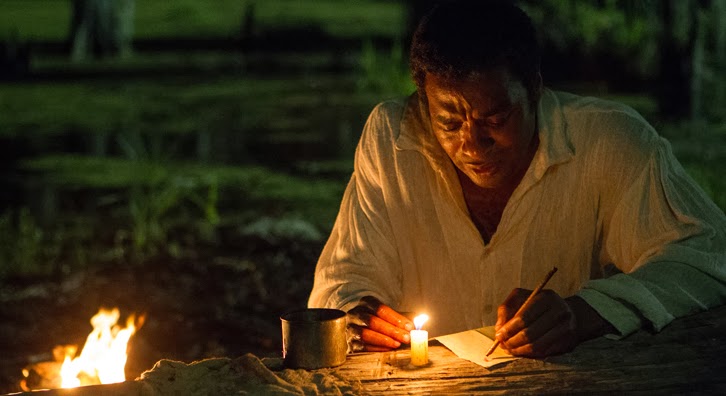
9. 12 Years a Slave:
This kind of film rarely escapes the life-nullifying grip of toe-ing the Politically Correct line, but this one very nearly accomplishes it. McQueen is one of our best, Ejiofor and Fassbender are both stunning; the telling of the story on a canvas stretched across the many years should be clunky but McQueen makes it seamless, timeless, and a joy. My complaint is that he shies away from the complexities of relationship, but that's a thing you give up when you have so many years to run across at a gallop. Also, there were moments when he lost me, like when the girl cries out that she wishes our hero had been the one to whip her.
For some fascinating insight into its flaws from someone who's read the source material, see Walter Chaw's review at Film Freak Central.
10. The World's End:
I was later to the party than most, having been less impressed by Shaun of the Dead than... well, anyone else I've ever talked to, actually, the result being that I failed to watch its follow-up, Hot Fuzz. Having greatly enjoyed Simon Pegg's turn as Montgomery Scott, however, I made it a point to traverse the Golden Mile to the World's End pub alongside the lads, and Pegg is now my total hero. More satisfying in every way than its American-Comic-Royalty counterpart This is the End in emotional gratification, dynamic flow, excitement, and sheer funniness, it's literally like nothing you have ever seen before, I guarantee it. (Except, maybe, Shaun of the Dead, which I don't frankly remember very well.) Plus, I love Rosamund Pike.
Also worthy of mention:
Gravity: This is the first movie I've seen in 3-D that didn't give me a headache, and I came out thinking, "That is exactly what 3-D is for." The test will be, once it comes out on DVD, whether it is watchable WITHOUT 3-D. (Go back and watch Hugo. Pretty dull, and certainly too long, once you strip away the tricks.)
Post Tenebras Lux: I can't say I loved it, but it was the boldest movie I watched all year, and I'm still thinking about its startlingly eldritch images and perfect, merciless editing.
We Are What We Are: *SPOILER ALERT* A cautionary tale against raising your kids to be cannibals, it's an impressive endeavour, with smooth camerawork, three-dimensional characters, a strong sense of backstory, and atmosphere to spare. It descends jarringly into (unintended?) comedy at the end, although even that bit carries the virtue of poetic justice. The acting is good, and Michael Parks deserves special mention in a gentle and true performance as the doctor who won't give up.
All said, its flaws are few, and it's easily one of the best horror films of the year.
In no particular order:
1. Stoker:
A darkly beautiful Gothic thriller, shot and assembled with brio and care. It's like getting the good parts of a Tim Burton film, the gorgeous palette and huge vision and attention to detail, without the kitsch and camp and script mishaps. It's best to go in knowing as little as possible, but if spraying blood and violent death make you squeamish, you may want to head for a different party.
2. the Lone Ranger and also here
3. Before Midnight:
If you haven't watched the other two and so haven't built up a relationship with Jesse and Celine, this may seem like getting caught in the middle of a marital thunderstorm, which is never pleasant. For those of us who have grown into adulthood alongside these people (because they do feel like real people. We've watched them age, seen the sameness and the differences), this is the best of the three. I have never before seen an ongoing conversation between long-time lovers which felt so extraordinarily true, and the fight they have is just flat-out courageous. Delpy in particular lets herself go way over the edge into bitchdom, which we all do in real life, just nobody ever does it onscreen, not in a real way. Hawke's Jesse, too, lets himself be very annoying (with his repeated accusations of her having "blown" other men), although it's clear that part of the problem in their relationship is that he is the "nice" guy, that she carries the bulk of the shadow in the household.
For many years, I was the anti-Hawke poster-child. A trusted friend once came to me and said, "There's this movie, Gattaca, you have to see it, you'd love it," and my response was, "I believe you, but I've taken an oath that I will not watch anything with Ethan Hawke in it." I did, too, I avoided all his movies for many years. This was the series which made me change my ways, and turned my mind around about him. (I'm still tentative, though. It was Reality Bites. Did you see that? I hated him so much in it that even in the wake of this "Before" series, a series I think as great as any trilogy ever made, possibly the greatest, even now I approach his films sidelong and slowly, ready to bolt at a single wrong move.)
4. Much Ado About Nothing:
The play itself is so extraordinarily well-written and its characters so engaging that no matter how often you see it, there are lines which never fail to delight. In this one, Benedick's "Your answer is enigmatical," is particularly pleasing, and Nathan Fillion and Tom Lenk as Dogberry and his Verges are an unexpected laugh-riot. (Unexpected because I always groan and roll my eyes when Dogberry comes onstage, but this version is whittled down to emphasize the funny bits, and Fillion is just the guy for the job.)
5. the Last Stand:
Ji-Woon Kim is right up there alongside Mel Gibson as a master at storytelling through action. He loves speed, yes, is intoxicated with copious, exaggerated amounts of it, but he also loves putting on the brakes suddenly to explore a slow, quiet moment, as when a bad guy gets his ear blown off, or the villain and the hero are driving sportscars through a cornfield and must stop and hover and listen. His pacing is perfect, and his exploration of dynamics is revitalizing.
There's some American cornpone, but that must be attractive to a first-time player in the American sandbox, and although a little Johnny Knoxville goes a long way, the second time I watched this I actually thought he was funny. Eduardo Noriega disappointed me: his voice is weak when he speaks English. In my favorite section, at the bridge, at the beginning of the final showdown, he seems to be imitating Eli Wallach from the Magnificent Seven, and I wish he had done more of that.
Great music.
6. Mud:
Sometimes I feel like a voice in the wilderness, calling out to unhearing masses about the consistently high quality of McConaughey's work, but I think my long years of faith are about to be rewarded. Between this and the Oscar-Obvious Dallas Buyers Club (so Oscar-Obvious, in fact, that I may not watch it), this may be his year to shake off the pretty-boy stoner label and find recognition among the real actors. (He has long belonged with one foot firmly in both camps, and why not? I love a guy who can surf.)
It looks on the surface like another boys' coming-of-age story, but it's really about love between men and women, about how near-impossible it is to learn and even harder to practice, and how tenuous it is even when you get it right. (As one boy says early on after another admits to a crush on a girl, "You know you'll have to talk to her," to which the other replies a little despondently, "Yeah, I know.") It bears some resemblance to Winter's Bone in its evocation of a backwoods existence, this time in the islands and riverlands of the South. Even secondary characters, like Michael Shannon as an unlikely parent-substitute trying his best, are clearly delineated and fully alive.
The young actors are good, all the actors are, but, as always, it's McConaughey who has the money scene. I don't want to give it away, but it involves a copperhead, and the glorious physical immediacy he brings to the sequence is a thing that few actors could conjure.
7. Room 237:
Relentlessly pursuing cinematic obsession and movie criticism into a beautiful realm of absurdity, Rodney Ascher has given four (five?) Shining fanatics of various levels of sanity free reign in which to expound their theories about the film at some length. We never see them, watching only footage from the original interspersed with various visual aids to further our understanding. The resulting connotations are intriguing: about how we immerse ourselves in film in order to investigate metaphysics, politics, and the other, vaster levels of life, about the complexities of mental labyrinths, and also a remarking on the wild genius of Stanley Kubrick, whose works inspire such overtime.
It's a tribute to the original film that, even in mere cuttings and kept at arm's length by narration, it still creeped me out to the point at which it was hard to sleep.
8. Ain't Them Bodies Saints:
Lodged firmly at the fulcrum point connecting Nick Cave (sans the ultraviolence) and Terrence Malick (but with both feet lodged firmly on the ground), it's an old story of crime and longing in old Texas, superbly shot and edited. Casey Affleck and Rooney Mara underplay to perfection, and the rest of the cast (Keith Carradine, Ben Foster, Nate Parker) follow suit.
9. 12 Years a Slave:
This kind of film rarely escapes the life-nullifying grip of toe-ing the Politically Correct line, but this one very nearly accomplishes it. McQueen is one of our best, Ejiofor and Fassbender are both stunning; the telling of the story on a canvas stretched across the many years should be clunky but McQueen makes it seamless, timeless, and a joy. My complaint is that he shies away from the complexities of relationship, but that's a thing you give up when you have so many years to run across at a gallop. Also, there were moments when he lost me, like when the girl cries out that she wishes our hero had been the one to whip her.
For some fascinating insight into its flaws from someone who's read the source material, see Walter Chaw's review at Film Freak Central.
10. The World's End:
I was later to the party than most, having been less impressed by Shaun of the Dead than... well, anyone else I've ever talked to, actually, the result being that I failed to watch its follow-up, Hot Fuzz. Having greatly enjoyed Simon Pegg's turn as Montgomery Scott, however, I made it a point to traverse the Golden Mile to the World's End pub alongside the lads, and Pegg is now my total hero. More satisfying in every way than its American-Comic-Royalty counterpart This is the End in emotional gratification, dynamic flow, excitement, and sheer funniness, it's literally like nothing you have ever seen before, I guarantee it. (Except, maybe, Shaun of the Dead, which I don't frankly remember very well.) Plus, I love Rosamund Pike.
Also worthy of mention:
Gravity: This is the first movie I've seen in 3-D that didn't give me a headache, and I came out thinking, "That is exactly what 3-D is for." The test will be, once it comes out on DVD, whether it is watchable WITHOUT 3-D. (Go back and watch Hugo. Pretty dull, and certainly too long, once you strip away the tricks.)
Post Tenebras Lux: I can't say I loved it, but it was the boldest movie I watched all year, and I'm still thinking about its startlingly eldritch images and perfect, merciless editing.
We Are What We Are: *SPOILER ALERT* A cautionary tale against raising your kids to be cannibals, it's an impressive endeavour, with smooth camerawork, three-dimensional characters, a strong sense of backstory, and atmosphere to spare. It descends jarringly into (unintended?) comedy at the end, although even that bit carries the virtue of poetic justice. The acting is good, and Michael Parks deserves special mention in a gentle and true performance as the doctor who won't give up.
All said, its flaws are few, and it's easily one of the best horror films of the year.
Wednesday, January 15, 2014
peter o'toole: gone to the great marcus luccicos room in the sky
He had a room in his house set aside for rehearsal and private study with a plaque proclaiming it "the Marcus Luccicos Room", named for a character mentioned early in Othello who never appears onstage. When he took on Macbeth, he tried to circumvent its infamous curse by referring both to the character and the play as "Harry Lauder", who was a popular Scottish entertainer from the early part of the 20th century. (It didn't work. The production was notoriously plagued by dark occurrences and opened to mortifying reviews.) When he retired, his statement read, "It's time for me to chuck in the sponge. To retire from films and stage. The heart for it has gone out of me: it won't come back."
All this is meant to point up that he was not only one of the great, completely original actors of our time, but also a man of charm, endearing whimsy, and great intelligence.
Here, from Nicholas Wapshott's 1984 biography, are some words of wisdom.
"I can't play inarticulates, I find. When I play reflective types I tend to reflect myself right off the screen."
"Success brings prizes, but most of them are consolation prizes. Mostly success has taught me to expect the right hand. Only now I know where to put my guard, because, believe me, it's coming, that right hand, and it's going to hurt. The trick is getting off the floor."
"What, am I older? Yes. Am I more profound? Not at all. All experience, in my experience, corrupts. You learn too many tricks. Tell me any experience you've had that has ennobled you?"
It is possible that one day Keith Richards and Tom Waits will die (although I am far from convinced of it). When they do, I'm certain I will suffer some kind of an existential crisis. That is not the case with O'Toole. I always knew he would die; I was, in fact, surprised that he outlived his drinking cronies Richards Harris and Burton. Still, it is a loss to be mourned, and if you have not followed his career, your life is poorer for it, and now's as good a time as any to explore. Be forewarned, however, that outside of two or three classics, he wound up in a lot of stinkers. (Katharine Hepburn, whose nickname for him was "Pig", used to tell him, "You're a bad picker, Pig." See Wapshott.)
Outside of the obvious (Lawrence of Arabia, Beckett, the Lion in Winter), you should watch 1980's the Stunt Man. It doesn't age particularly well, but his performance in it does, and it's an odd enough mélange of humour and dread and banality to leave a certain wake of possible greatness behind it. It was the last time he might have won an acting Oscar (I don't count My Favorite Year, because although he shines in the sending up of his own rakish persona, it is altogether too lightweight a project to tempt Oscar), and it was his misfortune that De Niro chose that particular year to play Jake LaMotta. Maybe my own favorite O'Toole performance is in the gargantuan, unwieldy, and utterly chilling Night of the Generals from 1967.
I wanted to mark his passing by watching Lord Jim and Murphy's War, two of his early, enigmatic films which I'd seen years previous and didn't much cotton to, give them a second chance to communicate, but Netflix is relatively O'Toole-poor, it turns out, so I settled on the three earliest available that were still unknown to me.
*SPOILER ALERT*
Zulu Dawn: (1979. dir: Douglas Hickox) I have a soft spot in my heart for these old nostalgia-for-the-empire British films. Before the English discovered they could make a mint on sentimental hogwash about the lower classes triumphing over hard times with the help of their mates (I think it was the Full Monty which kicked off that whole antic hay), the sixties and seventies followed up the success of Lawrence of Arabia with a ton of these old things: Young Winston, Conduct Unbecoming, this and Zulu come to mind. Hollywood pitched in, too, with my favorite, the Man Who Would Be King. Although they tend towards an elegiac quality and a general recognition of the political incorrectness of the whole demnable thing, this is the British version of Civil War movies which cast a wistful eye toward the Antebellum South. You know it's untenable; the way of the life was wrong and had to stop, but wasn't it pretty in its way? If your skin was the correct color, naturally.
Zulu Dawn recreates a particularly grim moment for the Empire: when hubristic governing aristocrats in the English colony of Natal, separated only by a river from Zulu lands, took it upon themselves to make war upon the natives, unleashing a horrific defeat at Isandlwana. It looks like an episode of Sharpe, as we spend time getting to know the various officers and lads, all played by stunningly good British character actors (Nigel Davenport, James Faulkner, Bob Hoskins, Simon Ward, Denholm Elliott, Ronald Pickup, to name only a few), then we spend a lot of time watching troop movements and observing the unwieldy nature of the English army traversing foreign ground. We come to know pertinent details, such as that the quartermaster plays exactly by the book, a habit which will be ominous in the heat and chaos of battle when he's handing out ordnance methodically, box by box, while the boys at the front are using it up as fast as they can shoot.
Although it's a grand and chilling moment when the hillsides darken with waves of barefoot, dark-skinned warriors, befeathered and chanting, the best part is the end: where they strive to save The Colours by riding them across the river, lose them to the enemy, then a downed officer manages to shoot the flag out of enemy hands and we watch it plunge into the water and curl down with the tide. After that, we ride with Peter O'Toole, the general most at fault for the massacre, who has taken his own sweet time to come to the aid of his central column, into a decimated, smoke-enshrouded camp, and end on a wonderfully lit view of his face as the enormity of the horror descends.
Zulu, from 1964, was Michael Caine's first role (and he's awfully good), and depicts the Battle of Roarke's Drift, a story just following this one, chronologically, but with a more upbeat ending for the denizens of the Empire. (And it's a better movie.)
How to Steal a Million: (1966. dir: William Wyler) Candy-coated sugar-flavored mid-sixties heist flick ala Topkapi and the Italian Job. O'Toole and Audrey Hepburn work easily enough together, but there's nothing earth-shaking here. It's edited for mega-panorama-epic-vision, so you get a ton of filler on either ends of scenes, always a screw-up as far as the precise dynamics of timing needed for both heist films and comedies, so neither aspect is entirely successful. The comedy is self-satisfied, over-written and heavy-handed. The whole movie, in fact, bears a feeling of weightiness, as if it were filmed using huge, unwieldy, immovable equipment, and it's just the opposite of the light touch such a venture requires. I believe O'Toole started taking these pretty-boy roles (starting with What's New, Pussycat?) because he wanted to be a heart-throb, and certainly to move away from the heavy-drama, man-alone impression he'd created with Lawrence of Arabia and Lord Jim. And he does have a nice, subtle touch with comedy. This is a failure, but not his fault, or Hepburn's.
Casino Royale: (1967. Multiple directors, including John Huston) It turns out that he just has the merest of cameos in this, a cameo in a movie made of cameos and schtick, and his may be the worst (he is playing bagpipes in a sort of hallucination sequence). It has more in common with Laugh-in and Get Smart than with the Bond films it's sending up. Some good actors give it a good try (special mention goes to Deborah Kerr for a fine but doomed effort), and Peter Sellers is the one who ends up shining most brightly. There's a bit in the middle done on mock German Expressionist sets which is amusing for a minute, it's got some very fine secondary turns by character actors you'll recognize, and, to its credit, it never claims to be anything but a schmaltzy tribute to psychedelic fun. Still, you'll probably fast-forward through some stuff.
Thursday, January 9, 2014
hammer of the gods: a half-assed night in valhalla
(2013. dir: Farren Blackburn) I always get my hopes up for Viking movies. Normally, I'm disappointed, and this is no exception. This may have been derived from a computer game; if not, it ought to have been that instead. It's got the "motley group on important quest" picaresque format, and revels in its violence (very badly edited, as is the absurd preference these days).
It's also extraordinarily well acted, beginning with the incomparable James Cosmo as the King of the Land at his Death-Time, and Charlie Bewley brings a startlingly light touch and easy grace to his turn as the youngest of the princes, a performance which shines when compared to, say, Sam Worthington in Clash of the Titans or even (my hero-worshipped) Fassbender in Centurion. (And it's all in a sense the same character, right? Strong, handsome hero worthier of our attentions because he's less calcified by his wonderful powers of machismo than are all the other macho guys around him.) Bewley, new to me, apparently learned his craft from the Twilight series, the Vampire Diaries, and Nashville, not a resume I'd have guessed for him, but something obviously worked, because he's got some skills.
The script, certainly not the worst I've ever run up against, still kept taking me back to my high school Senior All-Night, where part of the evening's festivities included a showing of Heavy Metal at the Varsity. I keep thinking that the roots of this movie delve further into that and Frank Frazetta than having anything to do with actual Vikings on English shores. Although, now I think of it, there is too much blather about what crap religion is (both of The Gods and of God) and how superior science is (although you never see any evidence at all of science at work here, only the glories of machismo and how they save the day). If you're not religious, then you still might be offended by the incest, fratricide, homophobia or matricide, but probably not, not if you're part of the targeted demographic (male gaming addicts between the ages of 12 and 19, I reckon). The mother-figure here is cut from the Only God Forgives cloth, except she's more extreme and hysterical. What is it with kids these days and their "evil mom" imagos? ("The same Great Mother who has given us life is speeding us toward extinction, and all in the service to a great mystery which befuddles the conscious mind, terrifies the heart and stirs the soul.” James Hollis, Mythologems.)
It's not the worst Viking movie you'll ever see, as long as your expectations are low. The colours are of the yawningly familiar teal and orange variety, and here's a drinking game for you: see who's the first among you to recognize the scenes lifted straight out of Apocalypse, Now! and Titus Andronicus, or the various pretentions towards replicating the power of Valhalla Rising.
Subscribe to:
Posts (Atom)