Wednesday, March 23, 2011

st trinian's: wicked and often well-armed


Removed from its context as a long-lived British cultural phenomenon, it's possible that Oliver Parker's 2007 St Trinian's makes little sense. This hellish girls' school began life in the comics of Ronald Searle just before WWII, and when he resumed them after the war (and his incarceration in a Japanese camp), the atmosphere darkened considerably. Five books of cartoons were followed by four films in the fifties and sixties arising from the Ealing tradition of comedy which drew heavily on panto and music-hall conventions. These were followed by a remake in 1980 (the Wildcats of St Trinian's), and, in 2007, this more recent addition to the ouevre. It stars Rupert Everett, stepping into the formidable heels of Alastair Sim as both the headmistress and her wastrel brother.


Wikipedia says of St. Trinian's, "Its pupils are wicked and often well-armed." As a general rule, the smaller the girl, the more dangerous she is; it is a pair of ten-year-old twins who are the school's weapons experts, or, as they are introduced, its "answer to the Sopranos." Older girls wrangle their schoolgirl costumes into slatternly streetwalker-wear. Gambling, drinking, smoking and drugs run rampant among all ages. (During a heist, one of the younger girls pulls out a fag and the head girl says, "You're only ten! Plus you're loaded down with volatile explosives.") Blinding and sometimes fatal bootleg vodka and other black-market wares are transported from the basement into the world by intermediary crook Flash Harry (here played by West Ham fan Russell Brand). Any amble through the halls will reveal girls being dropped from upper stairwells or immersed in fishtanks. The biology lab houses deadly biting ants and dangerous reptiles; the Spanish instructor teaches useful phrases like, "But these are not my suitcases. I have never seen this contraband before." As in any girls' school, there are cliques: first-years, emos, geeks, Posh Totties, Chavs. In the end, they all must work together to pull off an art-heist to save the school from bankruptcy.


Even for the uninitiated yank, there is an enjoyable ride here if you can relax into the bouncing spirit of the anarchy. The script is jam-packed full of inside jokes directed at Colin Firth (who plays the Minister of Education determined to make an example of the school), including an ill-fated dog called Mr. Darcy who loves to hump his leg. Although the girls indulge almost constantly in murderous games, nobody really dies (other than poor, doomed Mr. Darcy). The actors had a downright exorbitant amount of fun making this film, so much so that they all returned for a 2009 sequel, St Trinian's II: the Legend of Fritton's Gold, which adds David Tennant to the cast and has yet to swim the Atlantic and reach these shores.

And, in the end, there is something wonderfully satisfying about hearing a little towhead girl roar, "On my command, unleash hell!"

Wednesday, March 16, 2011

last night's double feature: tenderness and spirit of the beehive

Sometimes one stumbles upon synchronicity. I was loading the Spirit of the Beehive DVD when Tenderness fired up on Sundance and distracted me. In one movie, a girl witnesses a killer gently kissing his victim and becomes fixated upon the moment; in the other, a younger girl sees Frankenstein and fixates on the scene in which the monster kills a little girl, as if it holds the secret to finding her way into adulthood.


Tenderness: (2009. dir: John Polson) It's an atmospheric thriller: the suspense starts building straightaway and never lets up despite an unhurried pace. A killer is being released; a teenaged girl with a messed-up life seeks him out, associating him with the possibility of tenderness.

The tenderness of the title refers most obviously to a description of the killer's motive by Russell Crowe's police detective, a man determined to keep the boy from killing again. Having made a long study of it, he thinks the boy is addicted to the tenderness of the kill, the intimacy of sharing that last moment of breath. The siren call of tenderness, though, reaches far and wide beneath everything in this film, a thick vein of ore running just under the dirt.

In bookend narrations at the beginning and end, Crowe's character says (I paraphrase): "My wife always says there are two kinds of people: the ones who are looking for pleasure, and the ones who are running from pain." With two possible exceptions (the abusive stepfather-to-be, and Laura Dern as the boy's aunt, who seems healthier than everyone else but still lost and amazed at the anguish around her), even the characters who just duck on for a moment are all running from pain and, as a constant adjunct, seeking tenderness. Securing an ongoing source for-- not even love, which seems an impossible thing,-- just some tenderness, is the chthonic force behind nearly every decision made. There's a moment when a boy awkwardly approaches Sophie Traub's Lori at a carnival and offers to escort her around so that other boys don't hit on her. She cuts him coldly, but we recognize it as an echo of her own recent, heart-rending plea to the killer, with whom she is travelling: "Use me for whatever you want. Think of it as practice for when you find someone important." In fact, the movie is jam-packed full of moments of proferred tenderness, intimately captured by Tom Stern's unhurried camera, but I can't think of one which is experienced as such by two people simultaneously. Always the offer is either consciously rebuffed or goes unrecognized. Even Lori's boss, who we watch masturbating behind his desk while she expressionlessly lifts her shirt, looks on with a sort of melancholy longing as he lets her steal a CD.

You know from the beginning that not everyone is going to make it through to the end credits, but the story unfolds with gentle surprises, and the editing (by Lisa Zeno Churgin and Andrew Marcus) is spot-on, encouraging the space for introspection without letting the story lag. Even after having followed it with a classic like Beehive, this is the film I can't keep out of my head today.


The Spirit of the Beehive: (1973. dir: Victor Erice) This is what they call a visual "tone poem". It's gorgeous and filled with space and has no interest in spelling things out. Most commentaries will tell you that there are oblique, underground critiques here of Franco's regime, most prominently in the image of the family patriarch's experiment with a round beehive, which seems to inspire a mad chaos of fruitless activity amongst his bees.

All that is not the thrust, though, not the important part: Erice shows us his world through the eyes of two sisters, both very young. It is 1940. They live in a somewhat decrepit mansion in a tiny, isolated village in Spain with their mother, a remote and aging beauty who keeps for the most part aloof from her family and spends her time writing letters to a lover who is away at war, and their father, a keeper of bees and hunter of mushrooms, a man interested in the natural world around him but seemingly divorced from the larger world of humans.

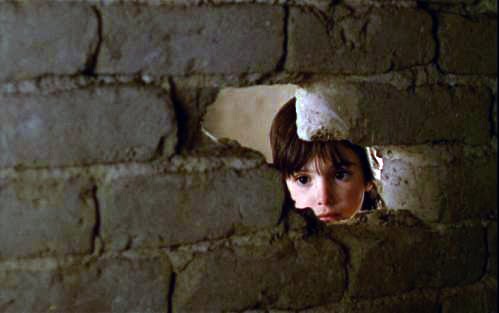
There is a special showing of Frankenstein in town and Ana, the younger of the two girls, becomes obsessed with knowing why the monster killed the little girl. Her older sister says it's a trick: the monster did not kill the girl and the monster himself is not dead. She knows this because she has spoken to its spirit and knows where it lives. This knowledge unleashes something in Ana and she begins pursuing an intimacy with the monster's spirit. There is a strong suggestion that the pull toward understanding the monster is the evolutionary force which pulls us all out of childhood toward adulthood, particularly after she watches from the sidelines while her older sister's friends leap over a fire in a coming-of-age pagan May Day ritual.

The climactic episode with the meeting of the monster is a gorgeous, timeless thing, and the easy denouement is ambiguous but in a good way, in the way that childhood becoming prepubescence is an ambiguous process.

Wednesday, March 9, 2011

last night's double feature: dominique is dead and valerie and her week of wonders


Dominique is Dead: (1980. dir: Michael Anderson) A few years after they collaborated on the laughable but nonetheless good-time Logan's Run, Michael Anderson teamed up again with Jenny Agutter, she of the ludicrously wooden acting style (to be fair, she's really at her worst in Logan's Run, as if she's just a teensy bit embarrassed). Dominique is a twisty-turny thriller from the "Is It Supernatural or Human Connivance?" realm, and it's packed full of cracking good British actors with little to do, alongside Cliff Robertson in the lead, whose natural stoicism works effectively against a hyperventilating script.

Jean Simmons is the eponymous Dominique. Her husband may or may not be trying to drive her to suicide, and her ghost may or may not later be trying to pay him back in kind. I stuck around to the end to find out, but Anderson really seems much more interested in playing around with Dario Argento's lighting kit than he is in telling a story, filling each night-time room with great splashes of primary colours through which the actors move as through a dream. I'm glad he had fun with that, and it's pretty to watch, -- although the film quality is so degraded that sometimes it looks like those Kodachrome snapshots from the sixties, where everything has bled into a mud of muted olives and oranges and very little else, and that's a shame, since it was mostly what this movie had to offer. Instead of growing tension, we get folks going up and down a shadowy staircase and back and forth through color-splashed hallways. In the end, although the writers did what they could to tie up all the ends, it still seems far-fetched in the way that Vast Government Conspiracies do (they can't keep a personal email bad-mouthing a foreign dignitary private, but the alien-dissecting lab under Roswell employing multiple scientists over the decades is still indeterminate?)


Valerie and Her Week of Wonders: (1970. dir: Jaromil Jires) Now travel with me back in time one decade further, hop with me across the pond then trek inland a spell where we happen upon one fabulously weird surrealist piece of Czech hippie-vision. It's not your typical flower-power kind of hippie, though; it's the sallow-faced long-hair at the party who doses you with Purple Owsley then mindfucks you into taking your clothes off. You wouldn't call it a horror film; rather, it's a girl's coming-of-age story, complete with the darkness, horror and cursed foreboding which balance the promise of sensual joy. I don't know where this director came from or went, but this movie, crazy as it is, moves with a firm hand at its rudder, as if he knows exactly where it's going all the time, even when we-the-spectators don't know exactly where we are or have just been. Valerie herself moves like Alice or Red Riding Hood with trusting ease through the high strangeness that is her onslaught of pubescence: a world of vampires, a Were-Weasel who may or may not be her father, incest, lustful priests, repressed grandmothers, virgins cursed with marriage, marriage likened to the vampiric bond, and a chicken plague. It's got the groovy sensuality of hippie times, but the interwoven darkness saves it from feeling outdated and tired like most flower-child memorabilia from stateside.

Wednesday, March 2, 2011

some films from the thirties


Son of Frankenstein: (1939. dir: Rowland V. Lee) This is a wonderful sequel! Why am I surprised? It's got Rathbone, Karloff and Lugosi: Rathbone is the titular, westernized son facing the infamy of returning to the spooky east to claim his inheritance, and inevitably succumbing to his dead father's obsession. Karloff is always superb, and Lugosi is in top form as the catalytic Ygor, looking like a sort of mutant son of Rasputin and the Wolfman, sporting pointy teeth and a broken neck. The tune he plays on his odd, homemade oboe to call the monster to do his bidding is mournfully eerie and the silence surrounding it is wonderful. There are big, strange, angular, Caligari-esque sets and extremes of chiaroscuro, and an inexplicable, boiling sulfur pit in the laboratory floor, always handy when you suspect there'll be monsters to destroy at some point.


Baby Face: (1933. dir: Alfred E. Green) It's one of the poster-children for Pre-Code Naughtiness: a young girl sleeps her way out of small-town poverty and across the country then into the upper echelons of big-city life. In her fifth year of speaking roles, Stanwyck is already a full-blown colossus. Look at the way she strolls down a street in Manhattan, straight off the boxcar floor and penniless, looking for all the world like royalty inspecting property she's about to buy. Already she can pull off even the most awful lines with aplomb. And a full eleven years before Double Indemnity, there's a lingering shot of her face while she listens to one of her lovers killing another in the next room, a shot every bit as magnificently enigmatic as the later, more celebrated one. This is also your chance to see John Wayne moping around as a lovesick office flunky wearing the boy-lipstick actors had to wear back then and looking pretty doggone silly. (If you want to see Gary Cooper looking silly in the boy-lipstick, check out his uncredited bit as a reporter in the 1927 Clara Bow monster-hit It.)


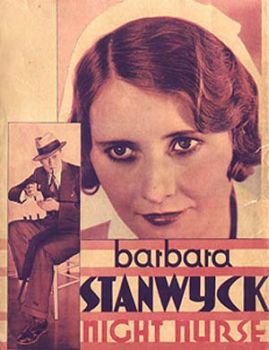
Night Nurse: (1931. dir: William Wellman) Another notorious pre-coder, this one is less concerned with telling a story than with letting us watch Stanwyck and Joan Blondell strip down to garters and slips multiple times as they climb in and out of their nursing gear. It's also got Gable from his pre-hero days as an SS-looking, black-clad, clean-shaven baddie who thinks nothing of socking Stanwyck across the jaw, although she's barely half his size. There's some simplistic suspense and unrealistic plot involving vulnerable kids and their nefarious parental figures, interesting because of the extreme depravity in which these rich no-gooders apparently live while their children quake fearfully in the arms of their nurse.


Night Must Fall: (1937. dir: Richard Thorpe) It's a great idea, but without the follow-through. According to IMDB, this was Thorpe's 107th full-length feature, including a disturbing number which had "g"s omitted from the titles (the Interferin' Gent, Roarin' Broncs, Trumpin' Trouble, to name just a few). The crucial thing he omitted from Night Must Fall was the sexual tension. Robert Montgomery is riveting, as he always is, as the smoothly ill-intentioned trickster who inveigles his way into the good graces of a clueless old lady (annoyingly written and annoyingly played by Dame May Whitty), but must somehow charm her more practical niece, played without her characteristic warmth and charm by Rosalind Russell. Smart as a whip, the niece at once suspects the intruder of being the sexual predator on the loose in the area, but can't bring herself to rat him out entirely. We assume this is because she's attracted to him, but since there is no chemistry between the two, her choices make little sense. Montgomery has summoned up a completely believable psychopath, a young man with charm and smarts who is constantly performing, constantly attentive to the reactions of others and adjusting his performance to suit. His sexual magnetism is not in question, although it is mired in that strange, impish androgyny which dead-ended Puers wield so consistently.

Suffering the back-drag of having been adapted from a play, the film never takes flight as it should, and Montgomery's performance is really the only thing to recommend it. It was remade in the swingin' sixties by Karel Reisz with the eternally un-charming Albert Finney as the psychopath, and I haven't brought myself to watch that one yet, although I'm certain that he's scary as hell, all subtlety has gone out the window, and there's sado-masochism a-plenty oozing up from beneath the tea-cozies.

Wednesday, February 23, 2011

last night's double feature: bonjour, tristesse and johnny eager

My DVD player, my trusted companion for these many years, has gone the way of all things mortal. One day it hesitated to open its drawer; soon it was refusing entirely, as if it were terribly weary and needed to sleep. I stuck coins on its little metaphorical eyes and put it out for the vultures to strip.

So until the new one shows up, I'm digging through my stacks of old VHS tapes while my Netflix languish on the coffee table. My original idea was to watch Bonjour, Tristesse and Little Girl Who Lives Down the Lane as a sort of coming-of-age evening, but Johnny Eager was too inviting and I couldn't pass it up.


*SPOILER ALERT*

I am far fonder of Bonjour, Tristesse than it deserves. Otto Preminger took a slim, cool, Electra-tinged and gallic hipster-novel and bloated it up to Hollywood size, saturating its colors, softening its sociopathic edges, pushing the very central sex at least out of the frame so that its constant pressure did not feel so very French. In fact, un-Frenching it sort of sums up Preminger's mode of operation.

The plot in a nutshell is this: the teenaged Cecile and her father are rich, beautiful, and live for fun along the French Riviera in the 1950s, using people for amusement and discarding them easily when they begin to bore or demand. When her dead mother's friend comes to marry her father and rearrange their lives, Cecile takes action, and tragedy ensues.

The very French Raymond who today would be played with lip-smacking gusto by Vincent Cassell is here presented with British charm and good humor by the very British David Niven, and the imposing, doomed, aging beauty Anne who ought to be played by Catherine Deneuve at age 47 is instead given to the unimpeachably British Deborah Kerr. There's something wonderfully earnest in the way Kerr listens to people onscreen which makes her palatable even when miscast, and of course Niven is always the soul of affability, important since his character is so shallow that in the wrong hands our sympathies might be lost entirely, and Niven never allows it.

The real centerpiece of course is Jean Seberg as Cecile, so ravishingly hip that if you saw her in a club today she'd STILL be the hippest girl in the room. My favorite part of the movie, in fact, is a b&w framing device Preminger uses to contrast the melancholy present with the vivacious and colorful flashbacks. Although Seberg's voiceover narration is wooden and uninspired, Preminger lets us gaze into her beautiful eyes for long stretches and follow her around Paris in the fifties while she deftly avoids emotional entanglement. My favorite bit is in a little underground dance club peopled by obvious bohemians (a young artist wearing the horizontally-striped shirt which was the stereotypical garb of the Bohemian Frenchman in Bugs Bunny cartoons, a lesbian dressed like Brando in the Wild One, et al). The painter and Cecile's more elegant escort begin fighting over her; without missing a beat, her face goes slack and she walks without a word into la chambre des dames to suffer her bad memories (which is what she does when she's alone) until they've sorted it out. My other favorite bit, also in the b&w frame, is when Cecile dances with her garcon-du-jour while Juliette Greco sings the cool, melancholy theme song. My OTHER favorite bit is the last shot, when Cecile finally shows us some genuine emotion. That's my favorite. We're building up to it, all film long, and the fascination of Seberg does not let us down.

In the end, it works for me despite the clenched-teeth, forced gaiety of the "fun" times, a fun which consists of gambling, eating out, drinking, and the occasional conga line; in short, a "fun" which is stripped of all truth or spontaneity and contrived by a scriptwriter under orders from a director that there's a big, epic party-scene needed and what can you come up with at short notice? It works in spite of clunky, cinemascope editing which lets the story lapse for long moments to show the epic scale of the set-pieces. It works against all odds because even when miscast, these actors know their chops. The awkward scene in which Anne overhears her lover betraying her, adeptly elided in the book and clumsily spelled out here, works because Kerr's face so easily and completely becomes the momentary embodiment of horror and shame.


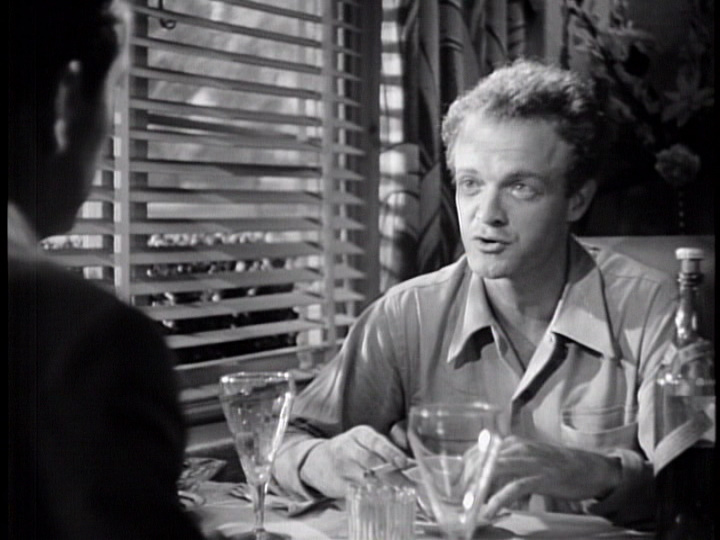
Then there's Johnny Eager. Brilliantly written. Never predictable. Lana Turner is impossibly luscious, and, it turns out, not a bad hand in the way of acting, or movie-starring, anyway. Robert Taylor does what is demanded and carries it alright, and Van Heflin steals the damn picture with his sad-sack intellectual sidekick, a role for which he took home one of those rare well-deserved Oscars.

This is not your everyday gangster picture. It's not only the script, it's the cinematography, too: unobtrusive but stunning choices about where to put the camera, how to frame, what face to show and when. There are big hunks of conversation during which Heflin's face is far too fascinating to ignore even though he's not talking at all, and Harold Rosson knows it.

Johnny Eager is one for the ages. It's easily one of my favorite gangster pictures: this despite a certain uncomfortableness I suffer with Robert Taylor, which has to say something, since he's in virtually every scene. I don't hesitate to call it one of the greats.

glorious 39: bold choices come to little


Glorious 39 is a strange, engaging, ultimately disappointing but ridiculously well-acted period-piece set in England during that last, golden summer before the war. I went in expecting one of those "Our Innocence is Lost; Our Ignorance was Bliss" nostalgia pieces, never thunder-striking but always worth a watch when brought to life by those marvellous British character actors. Instead, this turns out to be director/writer Stephen Poliakoff's well-polished stab at a historical thriller, along the lines of the Wyvern Mystery, in which the heroine feels absolutely loved and at home in the world and then something happens to pull the rug out and she winds up inhabiting a nightmare of doubt, wondering if she can trust anyone at all.

In the DVD extras, David Tennant describes Poliakoff as a British national treasure, which I think is rather generous; certainly two of the others I've seen of his (Close My Eyes and Perfect Strangers) are no great earthshaking pair. He does have a way of turning up the topsoil of British family-life in previous eras, particularly enjoying the company of the rich and landed, and presenting it in a palatable and often educational fashion. This time, he's exploring the idea that Neville Chamberlain's government was so certain England would lose a war with Germany that there was a campaign of intimidation and assassination against any poor sod who spoke out in favor of Churchill's bellicose plans. Although few of us today would scoff at the idea of a government acting cold-heartedly against its citizens (I'm speaking of Tories and Republicans, obviously) while justifying it as the means to an end, the thing as presented is pretty far-fetched. Poliakoff was apparently leaning so far towards the thriller aspect that he lost interest in logic.

The most chilling bit for me is when our heroine (Romola Garai) is detained at a roadblock without an identity card and the soldier explains with some po-faced Schadenfreude that Habeas Corpus has been suspended, and as soldiers they can now do what they like with whomever they please. The other effectively dread-inspiring moment is when the creepy young cousin warns her in hushed tones that her family doesn't love her. The grand pieces which are apparently meant to be the most chilling (at the eerie veterinarian's and at the diplomatic party) come off as forced and untrue, saved only by the (ridiculously) high quality of the acting. In fact, David Tennant gives such a magnificent turn that I resented his early exit. Bill Nighy is, as always, a complete master of all to which he turns his wonderful hand, and Hugh Bonneville and Eddie Redmayne hit just the right notes, without misstep. Poor Christopher Lee has the worst bit: he's part of an unfortunate framing device which culminates in one of the clumsiest pratfalls of an ending that I've ever had the bad luck to see.

It's too bad. Applying Hitchcock twists and darknesses to a historical piece is a grand idea. Casting all brilliant actors is another grand idea, and more folks ought to do it. Jeremy Northam as the aristocratic henchman of the evil government is perfect, and there's a wonderfully sinister shot in which he's eerily lit in the back of his car as the young folks watch him pull away, their instincts telling them he is a malevolent influence but their cheerful British common-sense arguing that the idea is rubbish. There's a stash of incriminating records disguised as foxtrots, cats stand in as mirror-images of those well-honed but often-quashed instincts, and every piece of furniture and prop is finely chosen and well placed. If only the story were better shaped. If only the plot turns were not so often forced and hard to swallow. If only the ending weren't an unpalatable cup of turgid tea.

All that said, all my complaints logged, I might still watch this again, just for the acting, and for the pleasure of living for another few hours in England before the War.

Wednesday, February 9, 2011

rowlands and cassavetes: a love song


Cassavetes films are agonizing. I've always found them so. I watch them at a rate of about one every three years; it takes that long to absorb one properly, and that long to recover from the experience. They're not agonizing in the way that, say, a Lars von Trier is, or, God forbid, a Gaspar Noe; HIS films set out to be agonizing first and foremost. Cassavetes tortures us not for the sake of sadism but because he has a massive hunger for cutting into life until he finds the gristle of truth. His movies are shaped like nobody else's, incorporating an extraordinary unpredictability, because his first concern is to gaze without flinching at the painful parts of life until unexpected honesties unfold and drop like gifts into our laps. His actors use an improvisatory style and the editing is unusual, often cutting away in the middle of what we would expect to be a much longer scene once the prospect of new truths has drained away from it, or, as in the bar scene in Husbands, staying three times longer with a scene than any other director on the face of the planet would have done. It's excruciating, but, as with any Cassavetes film, by the end of it one feels as if one has had one's old skin peeled away to expose a shiny, new one emerging from beneath the wounds.

Rowlands and Cassavetes are the only couple I've ever fallen in love with. As an actor, I find him so captivating that the only way I can look away from his face is if she is onscreen with him, and then I forget to watch him at all. This began in 1982 when I showed up early for a double feature and accidentally caught the last half hour of Paul Mazursky's Tempest. I knew who they were, of course. I'd seen Rosemary's Baby many times, and she'd just been up for the Oscar for Gloria. But it was Tempest where I watched them interact as husband and wife, and in that last, strange bit of that strange, small movie I saw something in the chemistry between them that made me stay over and watch it in its entirety.

And it IS a strange movie, with moments of utter brilliance competing against others of dismal, horror-show kind of failure, but Gena and John (may I be so affectionate?) are nothing short of stunning together. The thing that's hard to get past, -- the reason it's not for all comers, even Cassavetes fans, -- is that it carries about it a distinct I-Love-New-York-Musical-Theatre pong, a grating thing. The other difficulty, and this is a corollary to the first, is that the clowns (most notably Raul Julia's Calibanos) seem to inhabit an exaggerated, absurd theatricality which only makes sense in a Musical Theatre context. In Julia's defense, after repeated viewings I can say he really put his back into finding the truth in the emotional transitions, and I think no one in the world could have made a truer stab at this impossible task than he did.

But then to the good: Tempest has scenes which rank among my favorite moments in all of cinema. When the architect Phillip Dimitrius (Cassavetes) quits his job after watching his doppelganger jump from the top of a building site. When he tells his wife (Rowlands) that he wants out, a scene which includes a wonderful, merciless rant about everything he hates ("I hate this cat. I hate its face, with those whiskers..."), a rant which might be funny if it wasn't so devastating, and which winds up in the conjuration of a storm, a beautiful moment. The painful, protracted bit in which Dimitrius destroys his wife's (admittedly annoying) musical theatre party by showing up drunk and making a scene; the great part comes after the guests are gone. He falls on his knees in mock apology and she walks right past him, pushing him away by the forehead. The first time I saw it I thought, "This is the first real marriage I've ever seen in a movie." Then there's the long endpiece, the Tango of Forgiveness, in which relations get sorted out if not tied up, and which escapes a tang of the maudlin through its own embrace of the ridiculous and through that perfect emotional tone which Cassavetes and Rowlands seem to find with such astonishing constancy and effortlessness in everything they do.

That's what Opening Night has: excruciating as it is, as the Rowlands character goes through her nervous breakdown very much in public, there's that ebullient end-scene in which the show finally goes on, and we watch the two of them, husband-and-wife actors playing estranged-lover actors playing troubled spouses, improvising in front of a full house and doing it with such warmth, familiarity and plain good fun that it brings the house down. It's a great film, and a spectacular performance by Rowlands.

I could go on, but I won't. Suffice to say that I will watch these two in anything. One day, when they've finally mastered the principles behind time-travel, I'll produce a Reality TV series in which we go back and plant a camera crew in the Cassavetes/Rowlands household, and that will be the only Reality TV show I ever watch.