Saturday, July 6, 2013
three grisaille classics
A Cottage on Dartmoor: (1929. dir: Anthony Asquith) An astonishingly adept silent film from Britain. The story is nothing exceptional: boy falls in love with coworker, she falls for another, he is obsessed and tries to kill his rival, vows vengeance as he's taken into custody, escapes and shows up at their doorstep. It's the means of the telling which will take your breath away: Anthony Asquith moves effortlessly through time, using very few title cards, and we go right along with him. The only weakness is at the cinema: the segment during the Harold Lloyd short is too long and too randomly edited to build the intended suspense. Gorgeous framing and photography, almost German in its dark moodiness. The lead (Uno Henning) is handsome like Fassbender or Olivier, a little femme, maybe, but charismatic and intense and with a wonderful expressiveness.
Night Train: (1959. dir: Jerzy Kawalerowicz) A muddy print, and hard to find the subtitles, but this is a stunning film from Poland during a time when Polish cinema was coming into its own. The camerawork is extraordinary, like black-and-white Cassavetes, and in the same year that his first, Shadows, was ushered into the world. Since the bulk of the action takes place in the claustrophobia of sleeping cars and lurching train corridors, the cinematography is doubly impressive. Something unexpected, like a shot of the sweat stains beneath the doctor's arms, secretly communicates to us, underneath an ominous and continual overlay of menace. And the sound! The seething quiet of the sanguinary mob towards the end is uncanny, unforgettable, and the giddy camaraderie in the aftermath of the chase feels chillingly authentic.
It all works together: the slavic faces. The cool, hipster jazz. The underlying suggestion of political subversion. Leon Niemczyk is inscrutable, or just scrutable enough, in the stoical lead character, to keep us guessing and caring at the same time.
Green for Danger: (1946. dir: Sidney Gilliat) Marvellous wartime whodunnit from the fellows who wrote the Lady Vanishes. Trevor Howard and Allistair Sim lead a cracking good cast in a low-key murder mystery set in hospital whilst doodlebugs fall on the English countryside. Sim enjoys himself very much as the whimsical, chuckling detective with the mourdant sense of humour. Blitz-time England feels true to life, and the clues unfold at just the right pace. Although the suspects number only six, their motives are strong and believable enough to keep you guessing until the end. Filmed in lovely, warm black and white.
Wednesday, June 26, 2013
sucking in the fifties: virgin vs whore
Jubal: (1956. dir: Delmer Daves) I've had it up to here with the fifties and that decade's crazy crush on psychobabble replacing action, especially in a Western. This one has no action at all, just talk, talk, talk, which sometimes results in violence, but which doesn't feel like action, just childish acting-out.
There are two women: a Virgin (Felicia Farr), impossibly innocent and virtuous, and a Whore (Valerie French), impossibly wicked in her apocalypse-inducing lust. There's a cadre of fellows, mostly ranch-hands working for the affable and gregarious Shep (Ernest Borgnine), who is married to the Whore. Rod Steiger plays Curly from Of Mice and Men, and does it badly, all hyperventilation and scenery-chewing. Into this cauldron is thrown Glenn Ford's Jubal Troop, just the right mix of hero and outlaw to stir up a whole mess of broiling emotion, winding up in the cauterizing of a long-festering communal wound via death and restructuring.
Wikipedia says this movie is "notable as a reworking of Othello." Maybe in the sense that it's about jealousy, but that's where the resemblance ends. Also, Shakespeare could write very well. This script is the kind of thing a mediocre playwright writes when he doesn't have anything to write about but is too proud to sit and not write for awhile until he gets a decent idea.
It's too bad. Charles Bronson is good in his throwaway sidekick role, Ford and Borgnine do their usual good work. In addition to its other badness, it staggers beneath the ancillary burden of being one of those Mega Cinemascope Panoramic Epic pictures, so that every time Jubal has to walk from the corral to the house, we watch every step so that the cinematographer can show us how magnificently well the mountains behind him look on the big screen.
If it was a book, I'd have thrown it repeatedly against the wall every time I tried to finish a chapter.
Some Came Running: (1958. dir: Vincente Minnelli) And again, with the psychobabble. Talk, talk, talk. This movie is like poor-man's William Inge, and how much Inge really translates beyond the barrier of these many decades?
There are two good things, -- no, strike that: great things, -- about this movie. The first is Shirley MacLaine, who from the earliest age possessed a preternatural ability to attack even a badly-written role with such charisma, vivacity, and heart that she could physically drag a two-dimensional character kicking and screaming into a full, well-rounded third dimension. Anyone else, and I mean anyone, doing the bit in the nightclub where her Ginny drunkenly stumbles into the spotlight to sing, would have come off as an embarrassment. She is stupefyingly good, and not only in this outre kind of scene, but later, more quietly, confronting the teacher, and then finally convincing her beloved Dave (Sinatra) that her kind of love, however flawed, is true.
As for everyone else, it's all crap. Dino and Frank are, chillingly, Dino and Frank. Supposed to be a charming drunk, Dino cutely refers to the women he uses as "pigs", even when sober. Frank's Dave, supposed to be a very sensitive writer (we know because the scriptwriter has an objective and trustworthy character describe him so early on, not because Frank convinces us he is so), ostensibly falls in love with a teacher (Martha Hyer, wooden not like a tree, which has life and movement, but like a dimestore Indian, which has eyes and nose and mouth, but no animation at all), but, again, we only know it because he keeps protesting his love, not because we actually see any convincing evidence of it.
In fact, for all this film's ostensible obsession with uncovering its characters' psychological underpinnings, the psychology is crap. A guy like Sinatra (and, sorry, that's what he's playing: not a sensitive writer, but a guy like Sinatra) does not keep hangdogging around a prudish woman's door protesting his love. (Again, here, see that? Virgin and Whore. Just like the Western. There's even a scene where Sinatra "saves" his teenaged niece from life "as a tramp" because she's reacted to the knowledge of her father's infidelity by going out on the town with a stranger. There's only two ways, baby: virgin or whore, and one wrong move decides it forever. I'm paraphrasing, but that's the gist of it. What was WRONG with the fifties? And how can anyone -- I'm looking at you, Ronald Reagan,-- romanticize that crap?) I'm not saying no man would ever do that; I'm saying this is Sinatra we're talking about, and it pulls the rug out from under the whole, already stupid story.
And the Arthur Kennedy subplot? Forget about it. Next time, it winds up on the cutting-room floor.
There is one other great thing, though: that last carnival sequence. As written, it's nothing. The gunman is a mere plot device, a sort of Diabolus-ex-Machina, ridiculous, but the greatness is in the way it's filmed. It's like a number from West Side Story; Minnelli has filmed it in a slow-building whirl of dance-like motion and lights and color. A man with a gun pursuing a newlywed couple through a carnival crowd and another man trying to warn them becomes a whirling dance, gorgeously staged, shot and edited, so that every frame builds up tension, tension which has been entirely lacking for the rest of the goddamn film, I might add. So Minnelli manages to make a film that plods and sucks for two full hours, then caps it off with a climax of some full-on genius. Amazing. Not necessarily in a good way. I take my hat off, but only partly. Let's say I tip my hat without removing it fully from my head, alright?
Not that I'm blaming Minnelli. He started with a bad story, and there's no real escape from that. James Jones wrote the book, and this got made in the midst of a post-Eternity Jones-and-Sinatra-mania. Nowadays we make bad sequels to hit movies; back then, they made movies from books, and when they hit on a blockbuster, they raided the author's closets and drawers and garbage cans for further material. It's almost sweet, the idea is so innocent: giving the writer the credit for a good story. Trouble is, so many writers have only one or two, and then they start imitating Thomas Wolfe or William Inge or whoever the hell is the hipster god that year.
Wednesday, June 19, 2013
ancient tragedy in both the old west and the modern world, and a spaghetti western without the spaghetti
Dead Man's Burden: (2012. dir: Jared Moshe) God, how I love a Western that's like a Greek Tragedy (the Furies!), and this one is, like the Oresteia, only the war which has decimated the land is the Civil War and the family homestead is on the border of New Mexico. The curse on this low-rent House of Atreus involves the sins of the father, brother, sister, and interlopers, and blood must be paid for with blood. It's a great story and a decent script, the acting is good enough, although I salivate to imagine what someone like Fassbender would have done in the role of the husband, and to what heights a dose of charisma might have hauled this movie up.
It's good, but, sadly, it might have been great. I lay the fault down to the pacing, which has partly to do with dragging-places in the script but more fully, I think, to the bulk of it being set more by the sometimes intrusive orchestral score than by trusting the editor. There are other greenhorn glitches: creative camera angles counterintuitive to the scene (a showdown between potentially deadly enemies is shot from knee-height), a confusion about when to use close-up or medium shot.
I'd like to see this film remade with a heftier budget and a second party overlooking the script (Moshe, a long-time producer specializing in documentaries, wrote his own), along with the Stalking Moon.
Shotgun Stories: (2007. dir: Jeff Nichols) And speaking of Greek Tragedy transported forward in time...
Michael Shannon is often something spectacular to watch, as he is in this independent film about two feuding sides of one family. Jeff Nichols began with this quiet near-triumph, then went on to work again with Shannon on the breathtaking strangeness of Take Shelter. His latest is this year's Mud, which I have yet to see but from which I expect great things.
Like Take Shelter, Shotgun is not an easy ride; Nichols is a director who demands your full attention. The really fascinating writing is in the trickster called Shampoo (G. Allen Wilkins), sort of a Thersites character: not a family member, but it is he who keeps feeding a war which might otherwise smoulder down and lapse into attrition. It is he who first goads Kid (Barlow Jacobs) with news of his half-brother's taunts, then later rats out the same half-brother as the killer of a beloved dog. It is he who informs Son (Shannon) that the younger half-brothers were also involved in his brother's death, and he who shows Boy (Douglas Ligon) how to use a shotgun.
The mother is woefully miscast. There's a bold scene in which Son confronts her about her wrongdoing in raising them full of patricidal hatred, a scene during which she refuses to respond, does not speak at all. It might have been a wonderful piece de resistance had the actress communicated the kind of ice-cold and hot-with-hatred fury which would power such a lifelong vendetta, but all she brings to the table is a sort of bemused silence.
Still, Nichols and Shannon combined create a massive presence. Shotgun is, at its weakest, arresting, and occasionally ventures into low-budget magnificence, a bellwether pointing to brilliance to come from both men.
the Last Hard Men: (1976. dir: Andrew McLaglen)
*SPOILER ALERT*
Hollywood is trying to import the amoral brutality of the Spaghetti Western without simultaneously bringing its style and panache. Needless to say, the experiment doesn't work. McLaglen seems clumsy and uncertain at the helm, James Coburn and Charlton Heston are playing not humans but characters who never fully come to life, the plot is contrived and meandering. As in Ulzana's Raid and other Hollywood oaters from the time of the war in Viet Nam, the main thrust of the story seems to be the loss of a moral compass. The days when right and wrong were obvious to the man in the white hat are long gone, and no choice is ever entirely good in its repercussions. Barbara Hersey, still in her apprenticeship here, has not yet broken her cultural bindings, and so feels like a hippy amongst the outlaws. Her rape scene is brutal, arguably gratuitous, and because the "message" of the movie is vague, the scene feels filmed with an intent to pander sidelong to a leering, voyeuristic Schadenfreude.
Wednesday, June 5, 2013
big brother, a barbarian horde, and a search through the red-light district
the Anderson Tapes: (1971. dir: Sidney Lumet) Although no better than a mediocre film itself, it wears the honor of being one of the first of the Paranoia Films of the seventies, emerging in the same year as Klute, the French Connection, and Day of the Jackal, but preceding the other greats of the genre.
Apparently uncertain where to take it, this one was played for laughs, --albeit at a subdued chuckle,-- and it doesn't really work, although Dyan Cannon has a successfully dry and witty delivery. The "heist" parts don't work because of the slow pace, a result of forty ensuing years of ultra-acceleration. More damning is that Sean Connery is utterly miscast; it was a role designed for somebody much schlubbier. The characters as written remind me some of the Hot Rock, do you remember that one? "Afghanistan bananastand"? It seemed rompingly funny and suspenseful when I was a kid, and then a weirdly stubborn non-starter when I saw it again in late adolescence. (Mostly I remember the Mad Magazine satire. A lot of movies from the '70s and late '60s I remember that way. I never saw Love Story, but in the Mad version, the Ali McGraw character dies of a disease only found in Hollywood in which she becomes increasingly gorgeous until her final breath.)
The running "joke" in the Anderson Tapes is that many different private and governmental agencies are monitoring these criminals, with no two communicating with each other, and most of the taps are barely legal, if at all, resulting in more chaos than justice. That's the theme, albeit clumsily done, which keeps it interesting in the long run. Without it, it'd be forgotten as the Hot Rock.
Except that it also boasts Christopher Walken in his film debut, and he already has the skills and Intangible X-factor which set him apart from the rest of the pack.
Conan the Barbarian (2011. dir: Marcus Nispel) Khal Drogo and Daxos from Game of Thrones partner up to wreak Cimmerian vengeance on a father-daughter Axis of Evil (Stephen Lang and Rose McGowan; they're so good) who are determined to conquer the world through sorcery and deviltry. Whether you want to label the movie "epic in scope" or "pedestrian and interminable" will depend largely on whether or not you cared about the books. Although I hold a fond spot eternally in my heart for Arnold's old Conan movie, this one, this guy, Jason Momoa, is Robert E. Howard's warrior. ("I know not. I care not. I live, I love, I slay. I am content." CLASSIC.) Personally, I found the first third, with its backstory (poor Ron Perlman), pretentious narration (Morgan Freeman, naturally, who has officially inherited the Voice-of-God mantle from James Earl Jones), and yawningly predictable roller-coaster through hysterical melodrama, swelly Bombast-Musik and bathos, to be a pretty tough ride. As soon as the Sandmen attacked, though, I was glad I'd stuck with it.
Hardcore: (1979. dir: Paul Schrader) THIS is the follow-up to Taxi Driver? Thematically, sure, with clunky rendundancy. But the same guy wrote this lame-assed script? George C. Scott tosses himself in headlong and mines some nuggets of gold (or, anyway, pyrite) from this story about a religious man who loses his daughter to the Los Angeles porn industry and will burn down the world if that's what it takes to get her back. Mostly it comes across as contrived, removed, and trying to shock us with "truths" about the seedy underbelly of the city, and, like most things about porn, it suffers from an only half-acknowledged sense of the ridiculous. Because porn appeals not to the brain but to the, well, under-brain, its mechanisms always look embarrassing from the outside. One of the great things about Boogie Nights was that this, the main and over-riding "truth" about porn, was fully embraced.
The best part of the script is in fact when Scott's searcher (and he does have something in common with Ethan Edwards) describes the tenets of Calvinism to Season Hubley's "industry worker", then tells her she wouldn't understand, looking in from the outside. She replies, "Anything makes sense from the inside. A pervert one time came that close to convincing me to do it with his German Shepherd." And then, equal parts cynical and forlorn: "At least you get to go to Heaven. What do I get?"
Thursday, May 30, 2013
two fritz langs and a walter wanger
Ministry of Fear: (1944. dir: Fritz Lang) Right now, at this moment, this is my favorite Lang film of all. Stephen Neale (Ray Milland) is released from a madhouse (we don't know why until later; Lang is wonderfully coy with his exposition) during the heaviest part of the Blitz, and immediately steps into a chain of unsettling events. Milland has so amiable and capable a presence that we don't doubt all will turn out well, which assuages some of the bale from Graham Greene's book, for better or worse, but allows us to follow the very dark war-time spy-tale with confidence.
I was going to say that Lang unfolds his eerie story at an easy pace, but it's not easy, not at all. There are stuttering stops in it, dread-filled ebbs and pauses, emphasized by a master's use of shadow and light, but there is nothing easy about it. The war was not over when this was made, and it feels almost as if it's from a later time, a Red Scare "they're-under-our-beds" movie, only the Nazis are the ones who are suddenly everywhere in England, wearing English masks, speaking with posh, BBC diction. The innocent parts of life, --a cake won at a charity fete, a favor done for an elderly bookseller, minutes passing on a clock's face, the scissors of a tailor,-- twist into the darkest possible dangers, and the distinction between good guys and bad guys is nearly impossible to decipher. It's marred by a whimsically twee tag-on end-scene, but that is thankfully short, and the rest is marvellous.
Moonfleet: (1955. dir: Fritz Lang) It feels less like a Lang film than one of those Disney movies they used to show on Sunday night television when I was a kid. A little more violent, a little sexier, but just a little. I kept expecting Elsa Lanchester to emerge in a funny hat and bat someone over the head with an umbrella. It's charming, all the same, with Stewart Granger as nobleman Jeremy Fox, suaver than humanly possible while breaking hearts, running a gang of smugglers, fighting a duel with a rapier against a fellow wielding a halberd, and finding a wrench thrown into his works when the son of an old lover turns up on his doorstep. There's a spooky churchyard, the legend of a lost diamond, a pair of obvious aristocratic fiends (George Saunders and Joan Greenwood: you can tell straight off by the honey-tongued voices), also the hellish fury of a woman scorned (Viveca Lindfors, with funny hair and sultry gaze; see above), and a little boy's journey, not quite into manhood, since he's still very much in the dark when we leave him at the end, but a journey which anyway catalyzes Fox's own belated entry into adulthood.
Tap Roots: (1948. dir: George Marshall) A poor man's Gone With the Wind, with Van Heflin sporting both Rhett Butler's moustache and his particular brand of romantic cynicism, while Susan Hayward is the one having her bodice cinched tight whilst clinging to the bedpost.
As talk of secession mounts, the wealthy Dabneys, lords of Lebanon Valley in Mississippi, refuse to serve any masters at all, yank or reb, and send out a call that any who want to secede from both North and South should join them in their stubborn outpost. The story was ostensibly inspired by Newton Knight, a Mississippi rich man and Confederate deserter who refused to hold slaves and lived openly with his black wife, declaring his land holdings a free state, but poor Newton is betrayed by Alan Le May's screenplay, which is instead a pandering attempt to recapture the old GWTW magic, including fair-to-middlin' replicas of Mammy, Scarlett, Rhett, and Ward Bond as the family patriarch, who winds up wandering half-mad through the battle he's instigated in a near dead ringer for Thomas Mitchell's mad Mr. O'Hara.
It's a doomed project from the outset, because what can compete with the original? but Heflin and Hayward are good company, and it's given a racy understory, with the faux-Scarlett's faux-Ashley (in this version, he's paradoxically both far blander and far more villainous) betraying her with her sexy sister (Julie London) while she's confined to a sickbed.
Wednesday, May 22, 2013
loups-garous, siamese twins, and the siren call of oil
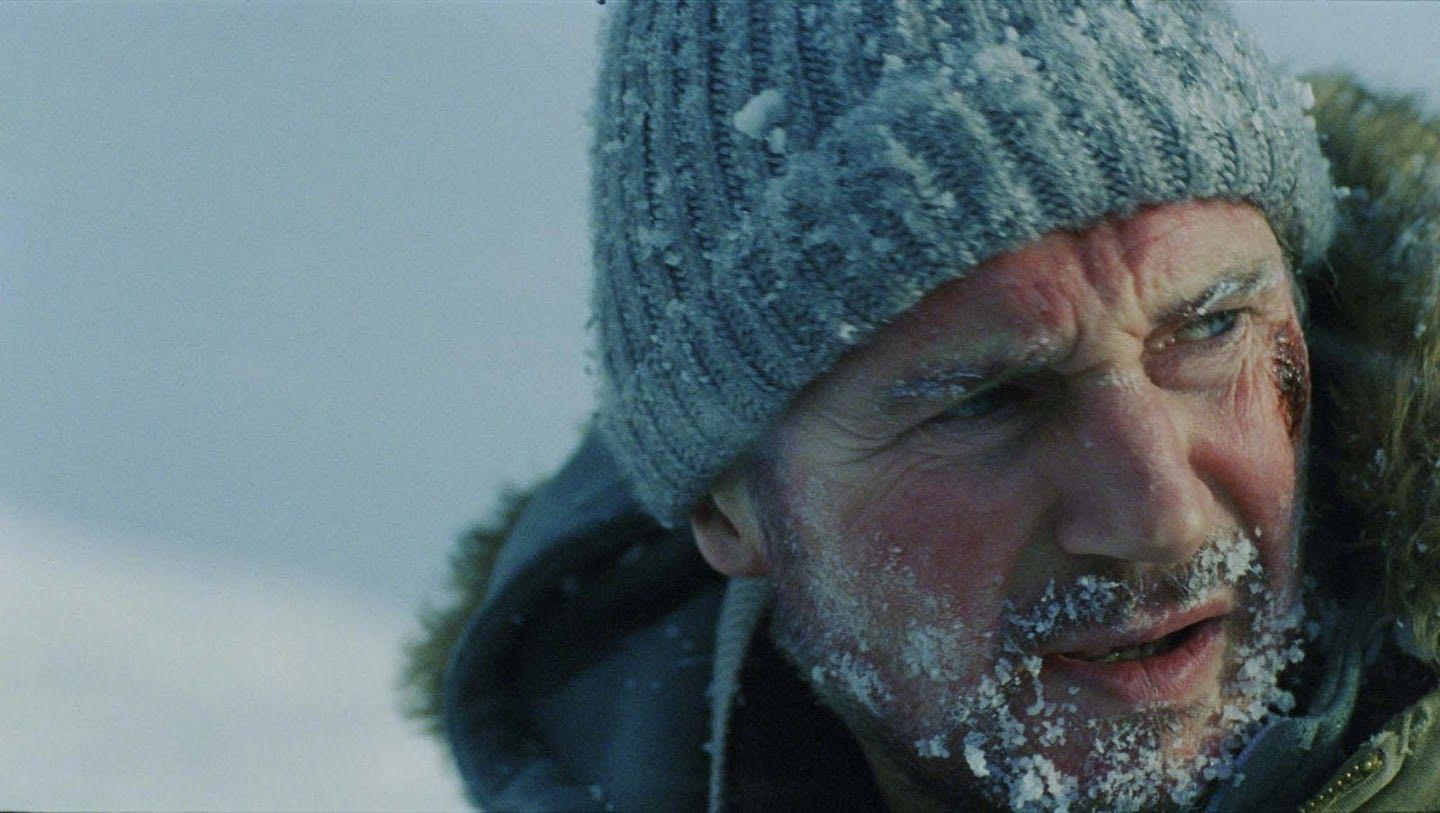
the Grey: (2011. dir: Joe Carnahan) As a contemplation on death and how to die with dignity and grace, the Grey is a lovely film, with good actors, photography, and use of sound and editing all interweaving to form a gorgeous memento mori. As an action film about unarmed men in the wilds fighting wolves, it is less successful: the wolves act (and look, and sound) more like monsters from a creature-feature than true predatory animals, and often they are deployed to jump-start the action when a new plot turn is needed. Liam Neeson, in the end, is the reason we watch: he wields both the chops and charisma to carry off the difficult final scene and, indeed, he is a perpetual magneto at the film's center, emitting magnificent pulses of electrical current throughout.
Sisters: (1973. dir: Brian De Palma) Yeah, there's Hitchcock in it, but also, interestingly, a slight portent of the approaching Cronenberg. De Palma's creative use of split-screen, drug-induced dream sequence, and a constant playfulness with his central motif of voyeurism gives this early venture an ageless vitality alongside its lodged-firmly-in-the-70s look. The performances and script veer wildly across the scale from pretty good to kind of silly, the vicious blood-letting scenes are made plain weird by blood thick like orange-red paint, and the final scenes are kind of a let-down, although I do love that shot of the cow standing next to the sofa in front of the railroad tracks.
Mostly, this is a piece of cinematic history, and should be viewed as such, from a time when De Palma was still fresh and his flaws were balanced and sometimes outweighed by his berserker levels of enthusiasm.
Day of the Falcon: (2011. dir: Jean-Jacques Annaud) The best thing about this movie is Mark Strong. The second best thing is that the editing is sufficiently smooth that we never have to linger long on any of the endless string of cliches from which the story is assembled. The third best thing is that it is beautifully colorful.
This is the putative story of how the Arab desert became the wealthy distributor of oil that it is today. If it has a remarkable virtue, it is that the only Westerners in it are the Texas oil-workers who instigate the trouble, and that their part is largely played off-screen. Everything else about it seems a little dubious (one comes away with a sense that it's been absurdly simplified and many evils shunted into unseen corners), outlandish (the army just happens to arrive at the stretch of strand from which they can see the fresh water bubbling up off-shore?), and, ultimately, dull. The lead character, a bookish boy grown into an unlikely military leader, is seriously boring.
The role of women is depressing to the point of inducing nightmares. Although Annaud tries to feist (and sex) up these (all drop-dead gorgeous) gals, every woman here either dies in childbirth, retreats into her bedroom to die of despair at her man's choices, peers out at the world with increasing frustration from behind the walls of a harem, or works shackled as a slave.
Sunday, May 19, 2013
mykelti williamson good times potsherds and muck double feature
Lucky # Slevin: (2006. dir: Paul McGuigan) Remember that guy Josh Hartnett? The first time I saw him, in the Faculty, I thought, man, this cat is going to be a MOVIE STAR, and made a mental note to keep an eye on him, observe his ascension into the heavens of cinematic immortality. Then he made the Virgin Suicides and I was like, yup, yup, here we go, hold on tight.
And then? Nothing. I mean, he was in Black Hawk Down, but so was everybody else, and everybody else didn't make Pearl Harbor the same year, a maleficent blot on the resume which spreads its spoiling stain across many an otherwise redemptive virtue.
I mean, this kid had everything: talent, looks, charisma, sex appeal, subtlety, chops. Was it a bad agent? an inability to cope with the crippling demands of good fortune in Hollywood (which, I believe, are many and often unbearable to those unfortunates born with talent and ambition but without a particular rhinosaurus-hide gene)? The killing blow came when he made, back to back, the appalling 40 Days and 40 Nights and Hollywood Homicide, a movie with a title so lame that I wouldn't watch it if it was serving a full all-you-can-eat buffet of all my favorite actors including Peter O'Toole when he was 25 and the long-dead Zbigniew Cybulski and directed by Kiyoshi Kurosawa.
My hopes, then, were slim for Lucky # Slevin, particularly since I tend to harbor suspicions towards the too-clever and too-hip cinema. This one, it turns out, is pretty good. It resides in the Usual Suspects category of trickster ventures, movies in which narrators may be unreliable and so the writer has to be very, very generous towards his audience to ensure that we do not feel duped in the end, but pleasantly surprised. This one was, and I was indeed pleasantly surprised.
It's chock full of good performances, my favorite being by Mykelti Williamson, almost unrecognisable in a small role as a simple-minded thug.
*SPOILER ALERT*
the First Power: (1990. dir: Robert Resnikoff) Forget 1990. This schlock has '80s written all over it, from the dread-filled Stewart Copeland synth-track to the cute-instead-of-sexy heroine with the massive shoulder-pads to the satanic-panic plotline. And, within those claustrophobic bounds, it is enjoyable. The plot makes no sense, none, and the characters never spring into life. There is not a single set that does not feel like a set, rather than a real place where real things happen, from dwellings to crime scenes ("We'll have a guy trampled by a horse-drawn carriage on Olvera Street, and they gotta find a crucified body suspended in the girders above the Los Angeles River") to the bar they stop into so the too-twee heroine can establish herself some street cred as a heavy drinker.
The thing it's got are some interesting performances. Williamson, for whom I watched it, sees his talents utterly wasted but is good-natured in his attempts as the cop's partner in the red shirt, doomed from the word "go" by his friendly disposition and lack of darkness. Poor fellow has to say things like "kiss my black ass," all the stuff the cop-partner had to say back in the '80s, and then he suffers an awkward and ignominious death scene.
One of the best performances is by Jeff Kober, hard-working journeyman actor who would later feature in Joss Whedon's stable in a rare, two-character run in Buffy: first as the mad vamp Zachary Kralik whom Buffy tricks into drinking holy water, later as the magic-pusher Rack who leads Willow down the slippery slope deeper into her addiction. (He's still working: he's been a regular on Sons of Anarchy recently.) In this, he plays the evil serial killer who is so beloved of Satan that he has been gifted with what the Catholic Church (allegedly) terms The First Power: the power of Resurrection. You see where I'm going with this? Once super-cop Russ Logan (Lou Diamond Phillips) captures him and sees him executed, he returns, more powerfully than ever, and seeking vengeance against our hero! The Church, in fact, plays an interesting role in this movie, a role that was common in the 80s but has since mellowed. It begins with a (visionary? or plain nuts?) nun warning the cynical cardinals that Satan is afoot in these murders, and, later, when push comes to shove, she steals a "treasured religious icon" --a dagger disguised as a crucifix, I kid you not,-- with which the mad demonic entity can finally be sent to hell where he belongs.
The other very fine performance is a one-scene wonder by TV actress Julianna McCarthy as the dead killer's grandmother. In an excruciatingly badly-written five minutes, we discover that the killer was the seed of his grandfather's rape of his mother, all embarrassingly badly done, except for this woman, whose dignity and clarity of choice convey not only truth but a certain enigmatic creepiness.
Subscribe to:
Posts (Atom)