Thursday, March 27, 2014

humoresque: the place is haunted


*SPOILER ALERT*

(1946. dir: Jean Negulesco) Neither Joan Crawford nor Clifford Odets has ever been better. Crawford had just won her Oscar for Mildred Pierce and her role in this one subsequently unfolded from a compact point into a broad canvas. The story is a John Garfield vehicle, heavy melodrama about a young musician and his older patroness, but the script is so vivacious that the thing rarely drags. Odets' humor is as dark here as it ever gets, dark and fast and fizzy, a cynical champagne of a screenplay, and the only times it starts to lag are in the "happy part of the love story" times, because the happy part of a love affair is the hard part to communicate. Plus, Odets doesn't believe in love, which further hampers his course.

The movie's true passion for classical music is fully apparent, and sometimes hypnotic. When Crawford pulls her Anna Karenina at the end, it's set to such a gorgeous piece and so beautifully photographed that you let the Wagnerian Soap Opera angle of it slide.

The other interesting thing (in these Hays Code times) is the despair which Crawford's character feels towards marriage. She's a dame who's been around the block a time or two and knows for a solid fact that Happily Ever After doesn't come after you say "I do", but also knows she's mad for this boy and wants to believe in it, the possibility of building happiness with him. It's that knowledge, that street wisdom, the inability to sustain the necessary illusion, which spells her doom. "Here's to love," she toasts, at the end, quietly, drunkenly, to herself, "and here's to the time we were little girls and no one asked us to marry." She's a nearsighted drunk who goes into physical ecstasy at the sound of Garfield playing his violin, and yet resents the music as the mistress who will always rule first in his heart. It doesn't scan, it's hard to buy, but everything looks and sounds so great, and Garfield and Crawford throw themselves so wholly into it, that you buy it anyway, without carping over the price-tag.

What a fantastic screenplay. Garfield, after the tragedy, is walking on the beach with his piano player. He's weary and wounded, and what momentous thought does Odets give him? "I have to shave. Why do I have to shave every day?" It's so real it hurts.

The Crawford character tells us she spends most of her time doing penance for things she does wrong every day. In one particularly good drunken scene in the bar she frequents, she keeps repeating, "No offence," to everyone, then, when the barman puts his hands on Garfield who's trying to drag her out and she tells him to back off, the guy says, "No offence," and Crawford, with that confused recognition drunkards get, says, "No offence? That's my line, no offence." Almost as good is her line when Garfield walks in to claim her: "Well, what do you know? The place is haunted."

And in his opening speech, Garfield gives us what might as well be the summation of every part he ever played: "All my life I wanted to do the right thing, but it never worked out. I'm outside, always looking in, and feeling all the time that I'm far away from home and where home is I don't know."

He is strangely at his ease as the violin virtuoso ascended to fame and fortune from poor roots. People will tell you that the movie doesn't really start until Crawford shows up, but that's hogwash. It's every bit as easy to lose yourself in Garfield as in Crawford; they're both superstars. This whole movie, in a nutshell, is better than you think it's going to be.

Wednesday, March 19, 2014

a revenant scarecrow, a sadistic nazi, and a fraught western triangle


*SPOILER ALERT*

the Dark Night of the Scarecrow: (1981. dir: Frank De Felitta) Television movies were on the whole pretty bad back in the seventies, but there's an infamous handful which transcended their designated medium entirely. The Elizabeth Montgomery Legend of Lizzie Borden is an obvious one, and there's a thing called Bad Ronald which is spoken of with fervor; I never saw it, but from what I can glean, it's about a boy who moves about inside the walls of a house.

Dark Night of the Scarecrow is another such: not a great movie, but one which transcends its budget, trappings, and expectation. It's a revenant vendetta film in which an innocent is wrongly executed, then returns for dark vengeance, generally using farm equipment. Frank De Felitta, who wrote the madly popular blockbuster Audrey Rose, directs. The script is oddly good, and the acting is exemplary, with Larry Drake as the backward victim, and Charles Durning, Lane Smith (one of those guys you'd know if you saw him, and go, "oh, THAT guy,"), Claude Earl Jones and Robert Lyons as the doomed malefactors.

The build-up is gripping, the pay-off is pretty good, and I learned a few things. Like, when you know you're being hunted with murderous intent and you hear someone in the loft of your barn, don't go up there. A few corollaries: don't get your courage out of a bottle, and be careful where you store your wood-chipper. Here's another: when there's heavy machinery bearing down on you in the middle of the night in an abandoned field, don't try and reason with the driver. If he were a reasonable human, he'd be at home asleep, or out having a beer. Just run, alright? One thing about farm equipment is that it doesn't move so quickly. You have a fighting chance, but not if you stand there like an asshole.

Anyway, scarecrows have a high creep factor. I recommend it as a low-key, unpretentious pleasure.


the Fallen Sparrow: (1943. dir: Richard Wallace) A truly dark, claustrophobic and unsettling just-pre-war noir based on a novel by Dorothy B. Hughes, one of the greats of pulp (In a Lonely Place is hers, and, good as the movie is, I prefer the book). We catch up with John Garfield just as he's recovering from having been captured while fighting in the Spanish Civil War and tortured for some time by a sadistic Nazi. He's been in Arizona recuperating, and now he's on his way back to the Big Apple to figure out why his good friend, the man who saved him from his ordeal, has mysteriously died.

The plot points don't quite hang together, and you have to stretch your credulity some. Also, Maureen O'Hara, lovely femme as she is, is just too damn nice and earnest to be the necessary fatale. (In her defense, since this was made while the war was underway, had her character been seen as in league with the Nazis, it would not have played well, and it was probably a directorial decision to strip her character of her traditional fatale-propulsion.) Aside from those quibbles, though, Garfield is completely believable, indeed, mesmerizing, as a tough guy who's been broken by torture then cobbled back together again through sheer moxie and will power, and the lighting is creepy-dark and creepy-good.


Three Violent People: (1956. dir: Rudolph Mate) Well, it's a Western, so there's some violence, yes. I suppose they're including Anne Baxter in the "violent" titular trio along with southern gunslinging brothers Charlton Heston and Tom Tryon, but it's the fifties, so she's not allowed to be truly fierce, except maybe in her love for her man and her baby, and even then she has to exercise some decorum.

It starts out with a John Ford sort of absurdity: the kind of courtship that only happens in an old Hollywood movie, with no dynamic except histrionics and power-struggle, a ridiculous courtship, an impossible courtship. Once that's done, though, we can get on to the real plot, which involves carpetbaggers up against proud, Texan landholders. One of the great weaknesses of the film is that Tryon, although pleasant enough company, is no match for Heston (or, for that matter, for Baxter); the part really called for a Richard Widmark or a Kirk Douglas or, hey, how about a Paul Newman? Tryon's got a sort of Ricky Nelson haircut and this was the age of Elvis, so I'm guessing that's the fan-base they were going for.

One of the best parts is Gilbert Roland, dignified and elegant despite a role in which he must say "chihuahua" over and over. He has a passel of sons, including Robert Blake and (I'm not making this up) Jamie Farr. Elaine Stritch is very good, too, as the madam who spells it right out for Baxter at the beginning, before the wedding, what's going to happen when her man finds out her wicked pre-marital secret, and damned if the madam isn't spot-on correct. It's the fifties, so there's a sudden baby without any sign of pregnancy to disfigure Baxter's tiny little waist, a baby who comes into the world without causing pain or even mussage of hair or makeup, a very polite baby.

You get the idea. There's good stuff here, shuffled in with fifties Hollywood absurdity. Unlike so many other Westerns from the time, though, it manages to triumph over its many flaws.

Wednesday, March 12, 2014

five unusual movies: three pretty good, two not so much


Casa de mi Padre: (2012. dir: Matt Piedmont) You gotta love Will Ferrell, even if you don't like Will Ferrell, for his bottomless well of shamelessness and enthusiasm. Even if, like me, you have had minimal exposure to the Mex-ploitation film industry he's sending up, this is still an enjoyable romp. Entirely in Spanish with subtitles, you get everything you'd expect: the asshole yankee DEA agent (Nick Offerman of Parks and Recreation, BRILLIANT), the flamboyant drug-lord and his newly-encroaching rival (Gael Garcia Bernal and Diego Luna, both having way too much fun), along with very funny pokes at magical realism (if nothing else, you have to see the Ferrell character's power animal) and filled to busting with continuity errors, bad timing, film glitches, buckets of blood splashed over slow-motion massacre scenes, subtitles which don't quite match the spoken words, even a scrolling apology from the second-camera assistant about why they couldn't use the fierce coyote-v-jaguar fight footage.

I laughed out loud twice, I think, but the rest of the time I was pleasantly amused.


Afraid of the Dark: (1991. dir: Mark Peploe) This is a low-key but truly harrowing double-story: about a boy going blind while trying to keep a grip on his life, and the same boy sighted but surrounded by blind people. The possibility of bloodshed lies around every corner, and the characters, having been well-written as normal, everyday people, seem terribly vulnerable and trusting. Utterly unconventional without descending into cleverness, chilling without sacrificing heart, and peopled by an astonishingly good cast (James Fox, Fanny Ardant, Paul McGann, Clare Holman, Susan Wooldridge, Robert Stephens, David Thewlis) speaking refreshingly good dialogue, it kept me on the edge of my seat right up to the end.


Deserter: (2002. dir: Martin Huberty) You watch it for Tom Hardy, sure, but it's also an interesting subject: a young Englishman of Romantic sensibilities (Paul Fox who, amazingly, seems NOT to have been spawned by the James/Edward Fox dynastical empire of acting talent) deals with a broken heart by running away to join the French Foreign Legion (La Legion Estrangere. Isn't that gorgeous?) only to find it a gruelling and decidedly unromantic row to hoe. The movie is lit, however, so that everything, --the desert, the medina in Algiers, the barracks, --everything looks beautiful, which you'd think would negate the point a bit, since the point (you'd think) would be the ugliness of reality. That's a red herring, though: really, this is a Hallmark-Movie-of-the-Week thing, designed ultimately to warm the cockles of your heart, convince you that the world is at last safe and warm and that destiny is in your corner, rooting for both your comfort and ultimate joy. That, in the end, all this which looks, at first glance, like chaos actually makes all kinds of sense, the fairy-tale, happily-ever-after, soul-mates-will-find-each-other and God-is-in-His-Heaven kind of sense.

I had hoped to learn some about the Algerian War of Independence, but this is all so simple-minded as to be a little insulting to everyone involved. (I did learn that when De Gaulle announced France would be pulling out and leaving the country to its own devices, the French Foreign Legion took over the airport and was on the verge of instigating a coup, which is interesting.) The worst of it is that there is a late, climactic moment between two great friends, a moment which ought to have been quite devastatingly effective, particularly since Tom Hardy was involved (and he is, as always, lovely in this). But because we are being led delicately by the hand as if children through a war-torn landscape bearing only the vaguest resemblance to anything in the real world, the moment passes without conjuring emotion. Or, anyway, conjuring something so small and un-upsetting that it bears only the vaguest resemblance to true emotion.

Recommended for Hardy completists only.


North Fork: (2003. dir: Michael Polish) An American town in the fifties is about to be drowned beneath a man-made lake. Pairs of men in identical gray business suits are dispersed to disearth the stubborn stragglers to higher ground. Simultaneously, a dying boy dreams his death-hallucination which brings the objects on his night-table to life.

An interesting monochromatic landscape, good cinematography, and a pace set at a daring but exact amble using a veritable battalion of very good actors cannot combat the boatload of whimsy involved, so particularly contrived as to be downright leaden, sinking the movie straight to the bottom where it thumps along, occasionally managing a raised flipper, but never rising into any true sign of life. Too bad. It was an interesting notion.


the Adjustment Bureau: (2011. dir: George Nolfi) A nice love story, care of Philip K Dick. Actually, I suspect much of the Philip K Dick has been filtered out, because it's a little too nice, a little too simple, but you can feel the author's sensibility still honored.

Pretty-boy Congressman David Norris is in the end-run for his Senate bid, and looking like a shoe-in when a frat-boy prank scandal threatens to end his political career for good. I should point out that this early part of the film, an accelerated, bullet-points-only view of his campaign, is masterfully done, giving us just enough to care about the guy, at the same time not hiding his insincere, politician side. (His campaign manager, wonderfully, is Michael Kelly, whom you'll recognize as Doug Stamper from House of Cards.) At this point we are introduced to a team of suited, tied, and hatted Men in Grey who are unknown to our characters but obviously pulling strings to move history in whichever direction suits them, including introducing Norris by apparent accident to Elise, who inspires him to give the speech of his life which puts him back on track to public office.

That's as much plot as I feel comfortable revealing. Suffice to say that Matt Damon and Emily Blunt are a good-time couple to hang out with; I've never enjoyed Damon's company so much. True, they do spend too much time running up endless staircases and opening doors onto terraces they just left, -- call it Philip K Dick, Escher-like, labyrinthine padding, --and the ending is far too tidy. Still, speaking as (on the whole) not-a-fan of romantic movies, this was my favorite in a long time.

Wednesday, March 5, 2014

destination tokyo: yanks in wartime


(1943. dir: Delmer Daves) It's a top-secret, ridiculously dangerous submarine mission which will take our heroes right into the heart of Tokyo Bay, running reconnaissance for what we now call the Doolittle Raid. The sub itself seems strangely roomy, and the men on it are largely good-hearted rascals mixed in with sober, milk-fed Kansas boys still learning what they're capable of. Cary Grant is the well-loved, stalwart captain. He tells stories not about courage under fire but about taking his little boy in for his first haircut and how he met his beloved wife on a blind date. John Garfield carries around a dame-shaped doll and tells endless tall tales about his adventures picking up gorgeous gals while on furlough.

There's a prolonged depth-charge attack, a "Nip" carrier cut in two by torpedoes bearing cheeky Yank graffiti, an emergency appendectomy performed with kitchen utensils by a kid who's taken a few pharmacology classes, a beloved crew-member treacherously knifed in the back while rescuing the pilot of a fallen Zero. This last affords Cary Grant with an opportunity to hold forth on how while good Americans give our five-year-olds roller-skates to play with, the Japanese give lethal weapons to boys of the same age, whole generations being raised for nothing but warfare and hatred. The speech is startling to hear today; substitute the word "Islamist" for "Jap" and history looks like a neverending circle.

Because it was made while the war was still on, there's no self-knowing slyness, no doubt about God or democracy that is not firmly and readily quashed. The jokes are corny and you're fair certain even in the worst darkness of explosions and spraying water that all will come out well in the end for our intrepid man-boys, but it's Delmer Daves' premier foray at the helm, he has something to prove, and, all in all, does so.

I love John Garfield best when his eyes are darkening with the realization of betrayal, his face relaxing into the "you got me again" sardonic smile, and there's none of that here. He is what he is: he knows he's been chosen for the most dangerous mission because he's got "a strong back, strong arms, and a weak head." He and Grant both take some borderline unbearable lines and make, if not real gemstones, then a fair facsimile of enthusiastic zircon out of them, and that makes this movie worthwhile. Just know what you're getting into: not only is it not for the post-modern, blase and jaded mindset, it is also absolutely incompatible with modern-day political correctness.

Wednesday, February 19, 2014

an uninspired count, a ghost story, and a family scandal


Dario Argento's Dracula: (2012. dir: Dario Argento) You can see it's him, that it's Argentino-ish, anyway, see it from the colors and extreme lighting (in this case, though, oddly flat and bright), and from the naked girls, including naked Asia Argento. But where's the master? I always thought even bad Argento was interesting (see Phantom of the Opera for some truly twisted imaginings), but this is just bad. It looks like he was filming a fairy tale for television, along the lines of Once Upon a Time, for example, except that the script is not good enough. (You heard me. Let that notion settle and simmer in your mind for a spell.) This script reads like it was written by someone who barely speaks English, and so is telling the bare-bones story with no subtlety, no grace, no elision. And, alright, the story of the bloodsucking Count is one that we KNOW already. We don't NEED the scene in which Van Helsing sits down with Mina and says, "The Count doesn't just drink blood, he changes his prey into creatures like himself..." We KNOW that. Just SHOW us things, alright? Didn't Argento used to be kind of a king in the realm of just showing us things from angles we never dreamt? or am I misremembering that?

On top of it all, the sound is awful, with bad dubbing throughout. It looks like it was made for television, with slow fades at commercial breaks. Even Thomas Kretschmann as the Count doesn't quite work. All those mad skills and charisma and even he needed something more: a script, yes, but maybe just some gothic trappings, some nice, mysterious lighting, perhaps, without which he's paddleless up a pretty humdrum creek. The music is nice and just-this-side of kitsch, using theremin and gypsy violins, but even that is not well-integrated.

On the other hand, how about that praying mantis, huh? Atta boy, Dario.


the Gift: (2000. dir: Sam Raimi) An old-fashioned ghost story done with easy, old-fashioned unfolding by Sam Raimi, with atmosphere to spare and a cast so great that they'll leave you sputtering with admiration. There's Cate Blanchett, amazing as usual, but also Giovanni Ribisi and Greg Kinnear, both of whom give stunningly good performances. Then there's Hillary Swank in a smaller role, and downright perfection as a downtrodden victim with a malevolent streak. Look at the way she walks, the way she hunch-shouldered sidles up to the woman she wants something from, stands too close, talks too quietly and insistently, manages to erase the presence of anyone else in the room. Really outstanding. Kim Dickens (Deadwood and Treme) also manages to demonstrate both chops and personality even in her do-nothing, I'm-a-plot-device, expositionary role.

Raimi uses a quiet, ambling pace, allowing the tension to build itself, and quaint old fade-outs at scene ends, which, God knows why, work well here. The story is a good one; the characters are good; the script is just good enough, and therein lies the rub. In the end, alas, we are asked to swallow too much, and so come away dissatisfied. Until then, though, it's really a nice ride.


the Stories We Tell: (2013. dir: Sarah Polley) I try to avoid documentaries people make about their own families. Generally they're using the camera as a weapon to get revenge on old grampa, or the people are awkward in front of it, whatever. But, just as even someone like me who hates weddings enjoys going to actors' weddings (because they understand the importance of timing, humor, dynamics, bold choices, and moving the damn thing along), Sarah Polley's family are a different kettle of fish, a family of performers. Her parents (well, "parents", in quotation marks, I guess) were actors and the kids tend towards a great, perhaps inherited, sense of showmanship. In short, they're a good time to hang out with. The great family "scandal" is not shrugged off, but also has good humor tossed its way along with some painful honesty. Polley has shaped things well and unapologetically, and provides both major parties involved wtih a good platform upon which to speak their individual pieces. The result is both interesting and surprisingly enjoyable.

Wednesday, February 12, 2014

last night's double feature: jigoku and images


Jigoku: (1960. dir: Nobuo Nakagawa) An early (perhaps the original?) Japanese example of what I call the "Bardo" film, in which the main character dies and has to wend his way through strange hallucinations, possibly real and possibly projections of his own guilt, before he can find his peace in death. Visually bold and unsettlingly edited, with a suddenness of scene change that lends pace along with eeriness and a continuing sense of threat, it shows us hell in every sense and from every angle. By incorporating both contemporary jazz and creepy theremin into the soundtrack, and by giving us a devil who is a young hipster, it feels both evocative of its moment and timeless.

By the roll of the end credits, it has long risen to a level of kabuki hysteria which is difficult to take seriously, but it's still a groundbreaking work of horror.


Images: (1972. dir: Robert Altman) Another fascinating study of a woman's descent into madness. Children's author Cathryn (Susannah York) and her wealthy American husband (Rene Auberjonois) go for a much-needed holiday at the country manor, where she has to fend off ex-lovers, both dead and alive, as well as an encroaching doppelganger, while carefully keeping track of which experiences are part of the "real", physical world and which exist in her (just as real) hallucinations. Altman kicks off the dis-ease with a jolt of Japanese horror-film music right through the credits over a montage of household items which already look weirdly malevolent beneath the eye of his camera, particularly when juxtaposed against the story which runs at a mad tumble through Cathryn's head, a story about children hunting unicorns. The husband's ongoing jokey banter approaches malevolence, too, and his three most constant props, --a camera, a long cigarillo, and a rifle, --all make vague but contiguous gestures towards an ongoing threat.

Why didn't I know about this film before? This is one of those happy things you stumble across when you're looking for something else; I found it (anomalously) on somebody's list of Paranoia films from the '70s(*). It was a smaller venture, filmed in England, wedged between Altman's major Hollywood outings McCabe and Mrs. Miller and the Long Goodbye, and perhaps it didn't get the press, but it's a wonderfully absorbing psychological thriller, and York is sufficiently earthy and grounded to get our hopes up for her salvation (unlike many actresses, who might have played up the ethereal, with too much of the changeling-caught-between-worlds thing. Picture, for instance, Mia Farrow or Isabelle Adjani in the role).


(*) Although there is certainly paranoia involved, it's too personal to fit onto a list including the Parallax View and the Conversation. It fits in rather well, though, with the new women's horror films of the time (Rosemary's Baby, the Stepford Wives, Repulsion, Let's Scare Jessica to Death). It also would not be out of place on a list including Roeg's Don't Look Now or Polanski's the Tenant.


Wednesday, January 29, 2014

my favorite films of 2013

These are my subjective favorites, not the ones I think "worthiest". (The most important film of the year is no doubt the Act of Killing, but I'll be damned if I'm going to call it a favorite.) On the other hand, nothing on this list is shabbily done; they are all objectively delightful in their own ways. It should also be noted the many I have not yet seen, including Inside Llewyn Davis, Her, American Hustle, Bastards, and, most crucially, Under the Skin.

In no particular order:

1. Stoker:

A darkly beautiful Gothic thriller, shot and assembled with brio and care. It's like getting the good parts of a Tim Burton film, the gorgeous palette and huge vision and attention to detail, without the kitsch and camp and script mishaps. It's best to go in knowing as little as possible, but if spraying blood and violent death make you squeamish, you may want to head for a different party.

2. the Lone Ranger and also here

3. Before Midnight:

If you haven't watched the other two and so haven't built up a relationship with Jesse and Celine, this may seem like getting caught in the middle of a marital thunderstorm, which is never pleasant. For those of us who have grown into adulthood alongside these people (because they do feel like real people. We've watched them age, seen the sameness and the differences), this is the best of the three. I have never before seen an ongoing conversation between long-time lovers which felt so extraordinarily true, and the fight they have is just flat-out courageous. Delpy in particular lets herself go way over the edge into bitchdom, which we all do in real life, just nobody ever does it onscreen, not in a real way. Hawke's Jesse, too, lets himself be very annoying (with his repeated accusations of her having "blown" other men), although it's clear that part of the problem in their relationship is that he is the "nice" guy, that she carries the bulk of the shadow in the household.

For many years, I was the anti-Hawke poster-child. A trusted friend once came to me and said, "There's this movie, Gattaca, you have to see it, you'd love it," and my response was, "I believe you, but I've taken an oath that I will not watch anything with Ethan Hawke in it." I did, too, I avoided all his movies for many years. This was the series which made me change my ways, and turned my mind around about him. (I'm still tentative, though. It was Reality Bites. Did you see that? I hated him so much in it that even in the wake of this "Before" series, a series I think as great as any trilogy ever made, possibly the greatest, even now I approach his films sidelong and slowly, ready to bolt at a single wrong move.)

4. Much Ado About Nothing:

The play itself is so extraordinarily well-written and its characters so engaging that no matter how often you see it, there are lines which never fail to delight. In this one, Benedick's "Your answer is enigmatical," is particularly pleasing, and Nathan Fillion and Tom Lenk as Dogberry and his Verges are an unexpected laugh-riot. (Unexpected because I always groan and roll my eyes when Dogberry comes onstage, but this version is whittled down to emphasize the funny bits, and Fillion is just the guy for the job.)

5. the Last Stand:

Ji-Woon Kim is right up there alongside Mel Gibson as a master at storytelling through action. He loves speed, yes, is intoxicated with copious, exaggerated amounts of it, but he also loves putting on the brakes suddenly to explore a slow, quiet moment, as when a bad guy gets his ear blown off, or the villain and the hero are driving sportscars through a cornfield and must stop and hover and listen. His pacing is perfect, and his exploration of dynamics is revitalizing.

There's some American cornpone, but that must be attractive to a first-time player in the American sandbox, and although a little Johnny Knoxville goes a long way, the second time I watched this I actually thought he was funny. Eduardo Noriega disappointed me: his voice is weak when he speaks English. In my favorite section, at the bridge, at the beginning of the final showdown, he seems to be imitating Eli Wallach from the Magnificent Seven, and I wish he had done more of that.

Great music.

6. Mud:

Sometimes I feel like a voice in the wilderness, calling out to unhearing masses about the consistently high quality of McConaughey's work, but I think my long years of faith are about to be rewarded. Between this and the Oscar-Obvious Dallas Buyers Club (so Oscar-Obvious, in fact, that I may not watch it), this may be his year to shake off the pretty-boy stoner label and find recognition among the real actors. (He has long belonged with one foot firmly in both camps, and why not? I love a guy who can surf.)

It looks on the surface like another boys' coming-of-age story, but it's really about love between men and women, about how near-impossible it is to learn and even harder to practice, and how tenuous it is even when you get it right. (As one boy says early on after another admits to a crush on a girl, "You know you'll have to talk to her," to which the other replies a little despondently, "Yeah, I know.") It bears some resemblance to Winter's Bone in its evocation of a backwoods existence, this time in the islands and riverlands of the South. Even secondary characters, like Michael Shannon as an unlikely parent-substitute trying his best, are clearly delineated and fully alive.

The young actors are good, all the actors are, but, as always, it's McConaughey who has the money scene. I don't want to give it away, but it involves a copperhead, and the glorious physical immediacy he brings to the sequence is a thing that few actors could conjure.

7. Room 237:

Relentlessly pursuing cinematic obsession and movie criticism into a beautiful realm of absurdity, Rodney Ascher has given four (five?) Shining fanatics of various levels of sanity free reign in which to expound their theories about the film at some length. We never see them, watching only footage from the original interspersed with various visual aids to further our understanding. The resulting connotations are intriguing: about how we immerse ourselves in film in order to investigate metaphysics, politics, and the other, vaster levels of life, about the complexities of mental labyrinths, and also a remarking on the wild genius of Stanley Kubrick, whose works inspire such overtime.

It's a tribute to the original film that, even in mere cuttings and kept at arm's length by narration, it still creeped me out to the point at which it was hard to sleep.

8. Ain't Them Bodies Saints:

Lodged firmly at the fulcrum point connecting Nick Cave (sans the ultraviolence) and Terrence Malick (but with both feet lodged firmly on the ground), it's an old story of crime and longing in old Texas, superbly shot and edited. Casey Affleck and Rooney Mara underplay to perfection, and the rest of the cast (Keith Carradine, Ben Foster, Nate Parker) follow suit.

9. 12 Years a Slave:

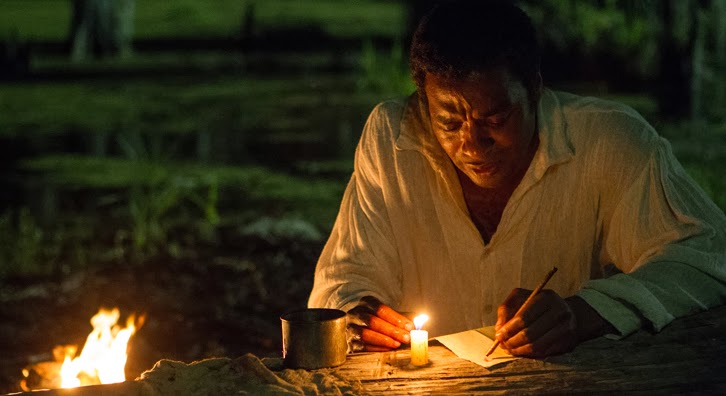
This kind of film rarely escapes the life-nullifying grip of toe-ing the Politically Correct line, but this one very nearly accomplishes it. McQueen is one of our best, Ejiofor and Fassbender are both stunning; the telling of the story on a canvas stretched across the many years should be clunky but McQueen makes it seamless, timeless, and a joy. My complaint is that he shies away from the complexities of relationship, but that's a thing you give up when you have so many years to run across at a gallop. Also, there were moments when he lost me, like when the girl cries out that she wishes our hero had been the one to whip her.

For some fascinating insight into its flaws from someone who's read the source material, see Walter Chaw's review at Film Freak Central.

10. The World's End:

I was later to the party than most, having been less impressed by Shaun of the Dead than... well, anyone else I've ever talked to, actually, the result being that I failed to watch its follow-up, Hot Fuzz. Having greatly enjoyed Simon Pegg's turn as Montgomery Scott, however, I made it a point to traverse the Golden Mile to the World's End pub alongside the lads, and Pegg is now my total hero. More satisfying in every way than its American-Comic-Royalty counterpart This is the End in emotional gratification, dynamic flow, excitement, and sheer funniness, it's literally like nothing you have ever seen before, I guarantee it. (Except, maybe, Shaun of the Dead, which I don't frankly remember very well.) Plus, I love Rosamund Pike.


Also worthy of mention:

Gravity: This is the first movie I've seen in 3-D that didn't give me a headache, and I came out thinking, "That is exactly what 3-D is for." The test will be, once it comes out on DVD, whether it is watchable WITHOUT 3-D. (Go back and watch Hugo. Pretty dull, and certainly too long, once you strip away the tricks.)

Post Tenebras Lux: I can't say I loved it, but it was the boldest movie I watched all year, and I'm still thinking about its startlingly eldritch images and perfect, merciless editing.

We Are What We Are: *SPOILER ALERT* A cautionary tale against raising your kids to be cannibals, it's an impressive endeavour, with smooth camerawork, three-dimensional characters, a strong sense of backstory, and atmosphere to spare. It descends jarringly into (unintended?) comedy at the end, although even that bit carries the virtue of poetic justice. The acting is good, and Michael Parks deserves special mention in a gentle and true performance as the doctor who won't give up.

All said, its flaws are few, and it's easily one of the best horror films of the year.